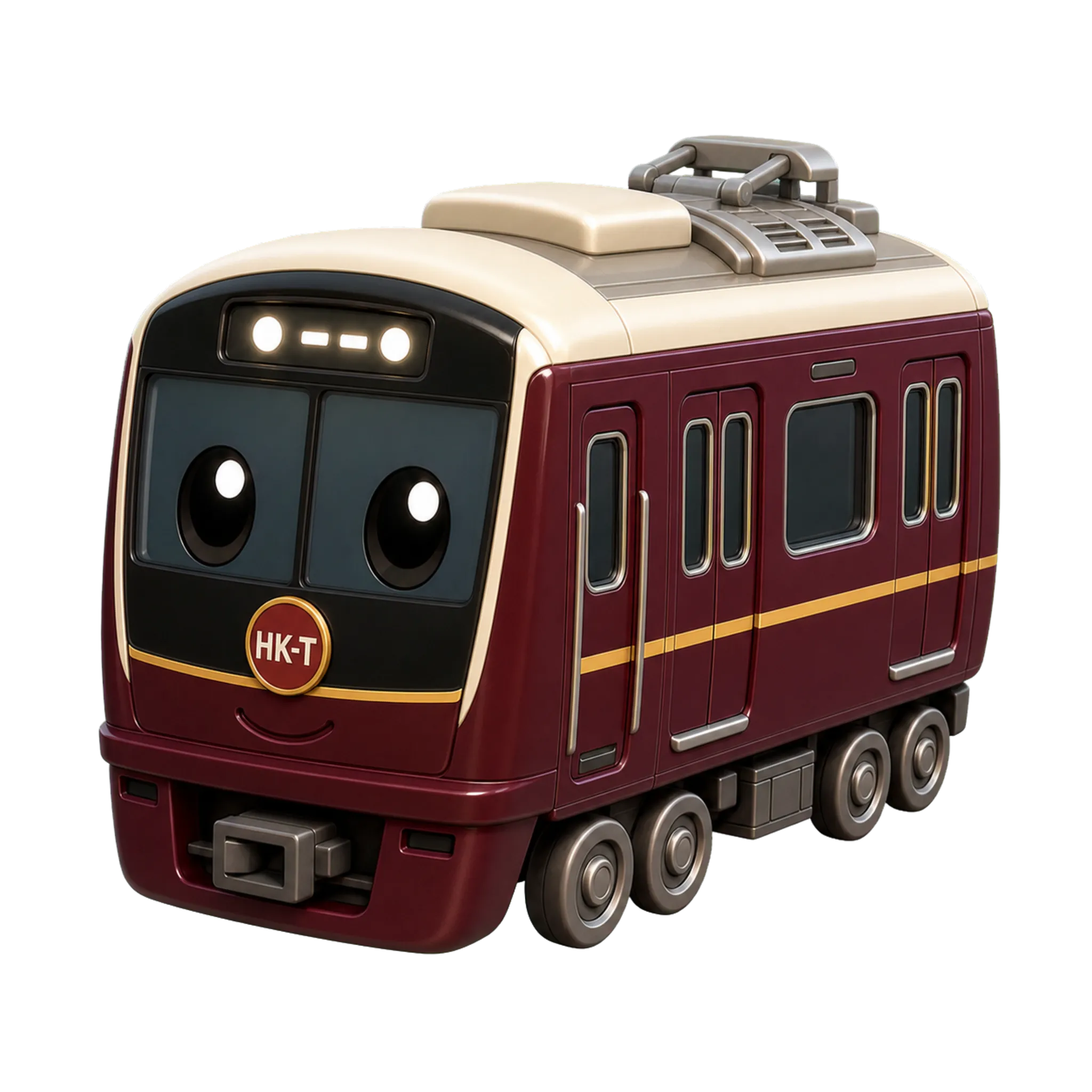
Overview
The Hankyu Takarazuka Line (HK) is the line Hankyu was born as. On 10 March 1910 the Minoo Arima Electric Tramway opened the whole 24.5 km from Umeda to Takarazuka at once — not a first section, the entire route — and then spent the next few years filling in stations along it: Hotarugaike that April, Sone in 1912, Nose-guchi and Toyonaka in 1913, Mefu-jinja in 1914. One of that first batch, Hirai, was closed in 1944 and survives only as the sub-name printed under Yamamoto on the signboards. The company grew around this line rather than the other way round: the Kobe Line branched off at Juso in 1920, and the Kyoto Line only started running through to Umeda in 1959, which is what finally made Juso the junction of all three Hankyu trunk lines. Two renamings are recent enough to catch out an old map. Hattori and Nakayama became Hattori-tenjin and Nakayama-kannon on 21 December 2013, the day station numbers arrived; and on 1 October 2019 Ishibashi became Ishibashi-handai-mae, after the Osaka University campus it serves.
Along the route
Out of Osaka-umeda the quadruple track is legally this line's. The Kyoto Line's trains ride its eastern pair, laid in 1959 on the old Kitano Line trackbed, which is why the Kyoto Line has no platform at Nakatsu; the Kobe Line runs alongside on its own double track, separated out in 1926. Three double tracks side by side, and only this line owns the ground. Past Juso it turns north-northwest through the dense inner suburbs — Mikuni, Shonai, Hattori-tenjin, Sone, Okamachi — to Toyonaka, then Hotarugaike, where the Osaka Monorail crosses on its way to Itami Airport. Ishibashi-handai-mae is the junction for the Minoo Line, a shuttle since the last through trains were abolished in the December 2022 timetable. Between Ikeda and Kawanishi-noseguchi the line crosses the Inagawa out of Osaka Prefecture into Hyogo, and at Kawanishi-noseguchi the Nose Electric Railway joins — the one through service on this line leaves here, the weekday rush-hour Nissei Express that Hankyu and Nose have run jointly to Nissei-chuo since 1997. From there the line swings west and runs west-southwest along the foot of the hills past the three temple-and-shrine stops in a row — Nakayama-kannon for Nakayama-dera, Mefu-jinja, Kiyoshikojin — into Takarazuka, where it meets the Imazu Line and JR's Fukuchiyama Line.
Why play it
Five of the nineteen names cannot be guessed from the kanji, and they are the reason to run this one. 蛍池 takes rendaku and is ほたるがいけ, not ほたるいけ. 売布神社 is めふじんじゃ — 売 as め, 布 as ふ. 清荒神 puts きよし on 清. 中山観音 is かんのん, not かんおん. And 雲雀丘花屋敷 is ひばりがおかはなやしき, six kanji without one regular reading among them and, at 22 keystrokes, the longest name on the line. Nakayama-kannon is also the keyboard party trick: かんのん wants nn before the の and nn again at the end, so it comes out nakayamakannnonn with three n's in a row in the middle. The terminus has a quieter oddity — 宝塚 is たからづか, so the engine's canonical spelling is takaraduka even though the sign says Takarazuka; both are accepted, so neither habit is punished. Add the long vowels the signs drop (Juso for juusou, Shonai for shounai, Kiyoshikojin for kiyoshikoujinn) and the sokuon in 服部天神, and the swing across the line is wide: 曽根 is four keystrokes, sone, against Hibarigaoka-hanayashiki's twenty-two.
Line data
Everything below is derived from the station data the game runs on, so it always matches what you actually type on the 宝塚本線 — all 19 stops of it.
- Operator
- Hankyu Railway
- Line symbol
- HK
- Stations
- 19
- Shape
- Terminal to terminal
- Termini
- 大阪梅田 — 宝塚
How much typing is this?
Typing every station name on this line takes 202 keystrokes, an average of 10.6 per station. The longest name is 雲雀丘花屋敷 (hibarigaoka-hanayashiki) at 22 keystrokes; the shortest is 曽根 (sone) at 4. Those counts come from running each name's kana through the game's own romaji engine, so they are what your fingers actually do — not the length of the printed spelling.
Along the way: 1 names contain a small っ, which doubles the next consonant; 3 contain a small ゃ, ゅ or ょ, where the engine accepts both the Hepburn and Kunrei spellings (sha or sya, shu or syu); and 3 end in ん, whose trailing n folds into whatever comes next rather than standing alone.
Where you can change trains
4 of the 19 stations on this line connect to another line in the game. Follow any symbol to that line's guide.
Every station on the line
All 19 stations in order, with the official station number, the name in kanji, the kana the typing is derived from, and its Hepburn romaji.
| # | No. | Station | Kana | Romaji |
|---|---|---|---|---|
| 1 | HK01 | 大阪梅田 | おおさかうめだ | osaka-umeda |
| 2 | HK02 | 中津 | なかつ | nakatsu |
| 3 | HK03 | 十三 | じゅうそう | juso |
| 4 | HK41 | 三国 | みくに | mikuni |
| 5 | HK42 | 庄内 | しょうない | shonai |
| 6 | HK43 | 服部天神 | はっとりてんじん | hattori-tenjin |
| 7 | HK44 | 曽根 | そね | sone |
| 8 | HK45 | 岡町 | おかまち | okamachi |
| 9 | HK46 | 豊中 | とよなか | toyonaka |
| 10 | HK47 | 蛍池 | ほたるがいけ | hotarugaike |
| 11 | HK48 | 石橋阪大前 | いしばしはんだいまえ | ishibashi-handai-mae |
| 12 | HK49 | 池田 | いけだ | ikeda |
| 13 | HK50 | 川西能勢口 | かわにしのせぐち | kawanishi-noseguchi |
| 14 | HK51 | 雲雀丘花屋敷 | ひばりがおかはなやしき | hibarigaoka-hanayashiki |
| 15 | HK52 | 山本 | やまもと | yamamoto |
| 16 | HK53 | 中山観音 | なかやまかんのん | nakayama-kannon |
| 17 | HK54 | 売布神社 | めふじんじゃ | mefu-jinja |
| 18 | HK55 | 清荒神 | きよしこうじん | kiyoshikojin |
| 19 | HK56 | 宝塚 | たからづか | takarazuka |