Overview
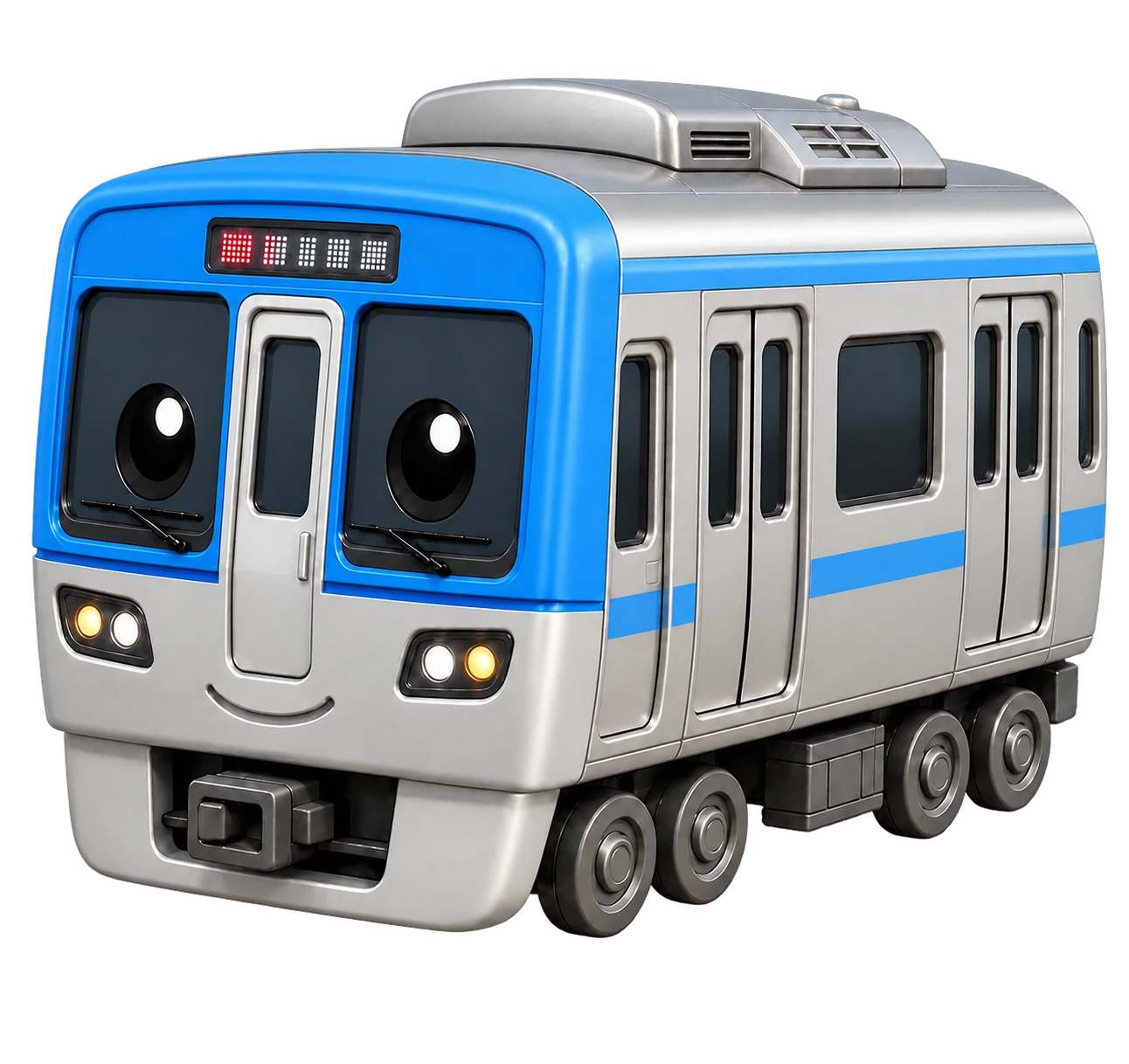
The Keio Inokashira Line (IN) runs 12.7 km from Shibuya to Kichijoji across the Musashino terrace, 17 stations in Keio blue — indigo blue, as the company calls it. It is Keio's second line here, and it is not a smaller Keio Line: it is a different railway that Keio happens to own. The line opened in 1933 as the Teito Electric Railway, built by the people behind the never-completed Tokyo Yamate Express Railway, and reached Kichijoji in 1934. It was folded into Odakyu in 1940, then into the wartime Tokyu conglomerate — the 大東急 — in 1942, which is when it took the name Inokashira Line. When that conglomerate was broken up in 1948 the line was handed not back to Odakyu but to the new Keio Teito Electric Railway, and the 帝都 in that company name was this line's dowry; Keio only dropped it in 1998. Odakyu was compensated with the Hakone Tozan Railway instead.
The inheritance shows in the track. The Inokashira Line runs on 1067 mm narrow gauge, alone among Keio's lines — everything else on the Keio side uses the 1372 mm horsecar gauge — so the two networks share an operator, an interchange at Meidaimae, and nothing else. There is no track connection between them at all; new trains are trucked in by road to a siding beside Eifukucho. And unlike almost every other major private railway line that touches the Yamanote, it runs through onto no subway at either end. What it does instead is run frequently and stop often: 17 stations in 12.7 km, an average of 0.8 km apart, close enough that from many platforms you can see the next one. The stainless-steel trains carry seven different accent colours — the "rainbow colours", a Keio livery used on this line and nowhere else.
Along the route
Shibuya's platforms sit up inside Shibuya Mark City, but the valley is deep enough that trains dive straight into the Shibuya tunnel, crossing under Dogenzaka and over the Den-en-toshi Line. Shinsen surfaces briefly — half its platform is already inside the next tunnel — and then the line runs out onto the Awashima flats past the University of Tokyo's Komaba campus to Komaba-todaimae, the only station here built after the war, formed in 1965 by merging Komaba and Todaimae. Past Ikenoue the track climbs onto embankment above dense housing, and at Shimo-kitazawa it crosses the Odakyu Odawara Line, which has since gone underground; until March 2019 you could still change between them without passing a ticket gate, a last trace of the Odakyu years, and the viaduct arches now hold the Mikan Shimokita complex that opened in 2022. Then Shindaita over the Kannana ring road, and the straight run to Higashi-matsubara lined with hydrangeas that Keio lights up when they flower, before the line swings right and ducks under the Keio Line into Meidaimae.
Beyond Meidaimae it crosses the Koshu Kaido and passes beneath the Tamagawa Josui aqueduct bridge — built wide enough for four tracks, a relic of the Yamate Express line that was never laid. Then a straight climb over the Kanda River to Eifukucho, four tracks and two islands, with the old depot site beside it now a bus garage. Nishi-eifuku and Hamadayama pass on dead-straight track; the line lifts onto viaduct by the Suginami incineration plant with the cherry-lined Kanda River alongside, and Takaido's platform crosses the Kanpachi ring road at right angles, elevated since 1972. Down again to Fujimigaoka and its depot, then Kugayama, then a run between embankments to Mitakadai and a hard right curve along the river to Inokashira-koen. The last stretch runs above the footpaths of Inokashira Park itself and climbs to Kichijoji, elevated since the day it opened — the line was once meant to carry on over the Chuo Line and out to Higashi-kurume, a plan that died with the ballpark it was drawn for.
Why play it
The Keio Line makes you type long; the Inokashira Line makes you type fast. Shinsen, Ikenoue, Shindaita, Takaido, Kugayama, Mitakadai, Hamadayama — しんせん, いけのうえ, しんだいた, たかいど, くがやま, みたかだい, はまだやま — four to six kana each, arriving one after another with the short station spacing to match. There is barely a long vowel on the line until Eifukucho. What replaces the Keio Line's marathon is a different problem: names that rhyme with each other. Eifukucho is followed immediately by Nishi-eifuku, which is the same word with a prefix and a suffix swapped, and Shindaita and Mitakadai are near-anagrams two-thirds of the line apart. Fujimigaoka is written 富士見ヶ丘 and read ふじみがおか — the same ヶ/が split the Keio Line hands you at Tsutsujigaoka. And the two names that do run long, Komaba-todaimae and Inokashira-koen, sit at station 3 and station 16: one before you have settled, one when you can already see the terminus.
Line data
Everything below is derived from the station data the game runs on, so it always matches what you actually type on the 井の頭線 — all 17 stops of it.
- Operator
- Keio Corporation
- Line symbol
- IN
- Stations
- 17
- Shape
- Terminal to terminal
- Termini
- 渋谷 — 吉祥寺
How much typing is this?
Typing every station name on this line takes 176 keystrokes, an average of 10.4 per station. The longest name is 東松原 (higashi-matsubara) at 16 keystrokes; the shortest is 渋谷 (shibuya) at 7. Those counts come from running each name's kana through the game's own romaji engine, so they are what your fingers actually do — not the length of the printed spelling.
Along the way: 0 names contain a small っ, which doubles the next consonant; 2 contain a small ゃ, ゅ or ょ, where the engine accepts both the Hepburn and Kunrei spellings (sha or sya, shu or syu); and 2 end in ん, whose trailing n folds into whatever comes next rather than standing alone.
Where you can change trains
4 of the 17 stations on this line connect to another line in the game. Follow any symbol to that line's guide.
Marked with a star: 渋谷 — the major interchanges, which the maps always label and the game marks with a heavier arrival stamp.
Every station on the line
All 17 stations in order, with the official station number, the name in kanji, the kana the typing is derived from, and its Hepburn romaji.
| # | No. | Station | Kana | Romaji |
|---|---|---|---|---|
| 1 | IN01 | 渋谷 | しぶや | shibuya |
| 2 | IN02 | 神泉 | しんせん | shinsen |
| 3 | IN03 | 駒場東大前 | こまばとうだいまえ | komaba-todaimae |
| 4 | IN04 | 池ノ上 | いけのうえ | ikenoue |
| 5 | IN05 | 下北沢 | しもきたざわ | shimo-kitazawa |
| 6 | IN06 | 新代田 | しんだいた | shindaita |
| 7 | IN07 | 東松原 | ひがしまつばら | higashi-matsubara |
| 8 | IN08 | 明大前 | めいだいまえ | meidaimae |
| 9 | IN09 | 永福町 | えいふくちょう | eifukucho |
| 10 | IN10 | 西永福 | にしえいふく | nishi-eifuku |
| 11 | IN11 | 浜田山 | はまだやま | hamadayama |
| 12 | IN12 | 高井戸 | たかいど | takaido |
| 13 | IN13 | 富士見ヶ丘 | ふじみがおか | fujimigaoka |
| 14 | IN14 | 久我山 | くがやま | kugayama |
| 15 | IN15 | 三鷹台 | みたかだい | mitakadai |
| 16 | IN16 | 井の頭公園 | いのかしらこうえん | inokashira-koen |
| 17 | IN17 | 吉祥寺 | きちじょうじ | kichijoji |