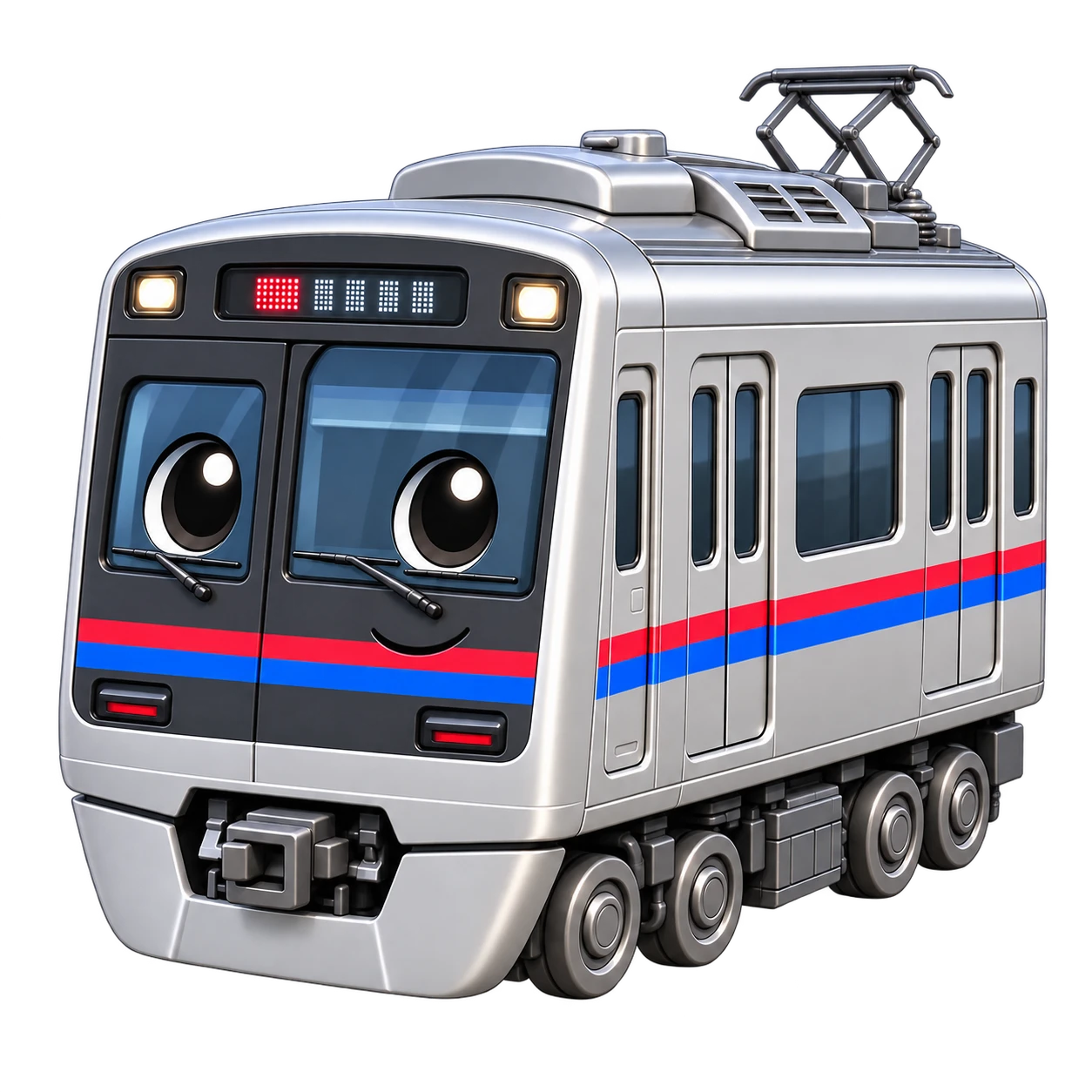
Overview
The Keisei Oshiage Line (KS) is short: six stations and 5.7 km from Oshiage, at the foot of the Tokyo Skytree, northeast through Sumida and Katsushika wards to the Main Line junction at Aoto. Its trains go much further: into the Toei Asakusa Line and on over Keikyu toward Haneda and Yokohama at one end, over the Main Line, the Hokuso Line or the Narita Sky Access at the other. Almost every train runs through, and the fast ones call only at the two ends.
It is also where Keisei began. The company's first trains ran on 3 November 1912 out of Oshiage, then its Tokyo terminal, and Oshiage–Aoto was part of the main line until 1944, when the route into Ueno through Nippori took that title. The line came back into its own on 4 December 1960, when Keisei and Toei Subway Line 1 — today's Asakusa Line — began Japan's first through service between a private railway and a subway, Keisei having moved its Oshiage platforms underground five days earlier to meet the tunnel.
Along the route
Oshiage, shared by four railways, has carried the sub-name "Skytree-mae" since 2012. The line climbs out of the tunnel onto a viaduct finished in 2015 to Keisei-Hikifune, which opened in 1912 as plain Hikifune and gained its 京成 in 1931; Tobu's Hikifune, about five minutes' walk away, kept the bare name. The Kyojima streets around it are among the few parts of Tokyo the wartime air raids missed.
Yahiro was called Arakawa until 1 April 1994, after the river embankment it stands on — a name that kept sending people to Arakawa ward, on the far side of the city. The new one belongs to the neighborhood, coined in 1965 from 八, the lucky number whose shape spreads wider toward its foot. Yahiro has a third track, the only place on the line where a fast train can pass a local, and the two directions have to share it.
Then the Arakawa itself. The old bridge sat so low that ships kept hitting it — a tanker struck it on 5 January 1991, bending the rails and closing the crossing for days — and its deck sat below the flood embankments on both banks. A higher bridge replaced it in 1997 and 1999, and Yahiro and Yotsugi went up onto viaducts with it. Yotsugi is the hometown of Yoichi Takahashi, the creator of Captain Tsubasa; since 2019 the station has been dressed in the manga's characters and plays the anime's theme song as trains approach.
Keisei-Tateishi is at ground level for now, in the middle of works to raise the tracks from Yotsugi to Aoto, and its dense little drinking streets draw people who neither live nor work nearby. The line ends at Aoto on a two-level viaduct: trains toward central Tokyo on the lower deck, outbound trains on the upper, so changing between the Oshiage Line and the Main Line in the same direction is a walk across the platform.
Why play it
Six stops and 52 romaji keystrokes make this one of the shortest runs in the game, and there is not a ん, a small kana or a doubled consonant anywhere on it — every trap is a reading. The two longest names, 14 keystrokes each, both start with けいせい, so "keisei" comes twice in four stops; the board's hyphen is not typed, just "keiseihikifune" straight through. 八広 is やひろ, reading 八 as や. 四ツ木 is voiced — よつぎ, "yotsugi", not "yotsuki" — and the station writes it with a katakana ツ, while the neighborhood around it is 四つ木 with a hiragana つ. In Kanji mode those are different characters: commit 四つ木 and only the 四 is kept, with a miss on the board.
The finish is the shortest name on the line and the sneakiest. 青砥 is just "aoto", four keys, but the district and postal address around the station is 青戸, read exactly the same way. An IME may well offer 青戸 first, and only 青砥 counts: the station is named after Aoto Fujitsuna, the samurai of the Taiheiki tales, not after the place.
Line data
Everything below is derived from the station data the game runs on, so it always matches what you actually type on the 押上線 — all 6 stops of it.
- Operator
- Keisei Electric Railway
- Line symbol
- KS
- Stations
- 6
- Shape
- Terminal to terminal
- Termini
- 押上 — 青砥
How much typing is this?
Typing every station name on this line takes 52 keystrokes, an average of 8.7 per station. The longest name is 京成曳舟 (keisei-hikifune) at 14 keystrokes; the shortest is 青砥 (aoto) at 4. Those counts come from running each name's kana through the game's own romaji engine, so they are what your fingers actually do — not the length of the printed spelling.
Along the way: 0 names contain a small っ, which doubles the next consonant; 0 contain a small ゃ, ゅ or ょ, where the engine accepts both the Hepburn and Kunrei spellings (sha or sya, shu or syu); and 0 end in ん, whose trailing n folds into whatever comes next rather than standing alone.
Where you can change trains
2 of the 6 stations on this line connect to another line in the game. Follow any symbol to that line's guide.
Marked with a star: 押上 — the major interchanges, which the maps always label and the game marks with a heavier arrival stamp.
Every station on the line
All 6 stations in order, with the official station number, the name in kanji, the kana the typing is derived from, and its Hepburn romaji.
| # | No. | Station | Kana | Romaji |
|---|---|---|---|---|
| 1 | KS45 | 押上 | おしあげ | oshiage |
| 2 | KS46 | 京成曳舟 | けいせいひきふね | keisei-hikifune |
| 3 | KS47 | 八広 | やひろ | yahiro |
| 4 | KS48 | 四ツ木 | よつぎ | yotsugi |
| 5 | KS49 | 京成立石 | けいせいたていし | keisei-tateishi |
| 6 | KS09 | 青砥 | あおと | aoto |