Overview
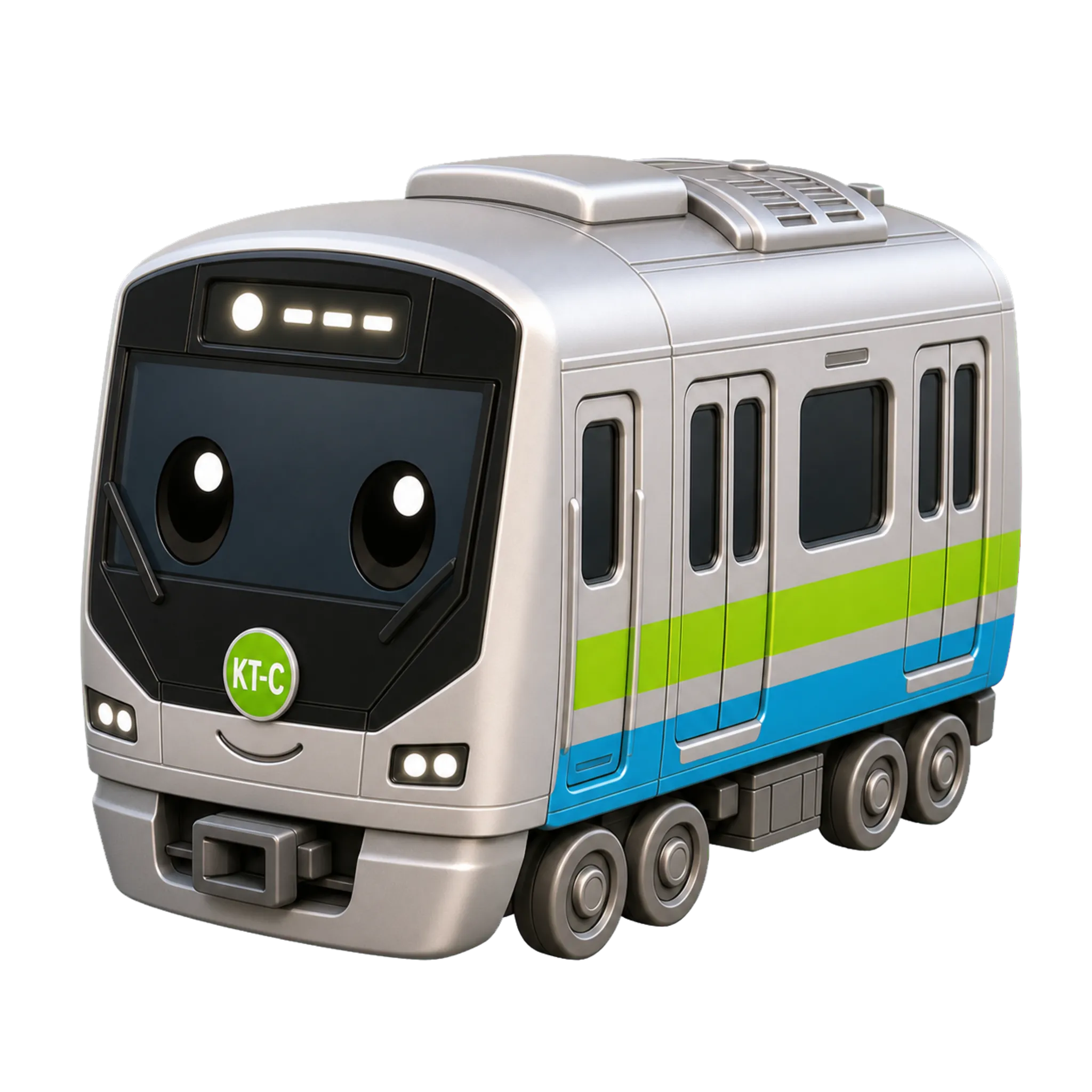
The Keihanna Line (C) is Kintetsu's way east out of Osaka — eight stations and 18.8 km from Nagata, out of the Higashiosaka flats and over the Ikoma range to Gakken-Nara-Tomigaoka. It opened in 1986 as the Higashi-Osaka Line, running only as far as Ikoma, a bypass for the chronically congested Kintetsu Nara Line that ran through onto the Osaka municipal subway's Chuo Line from day one. To match the subway it takes 750 V DC from a third rail rather than Kintetsu's usual 1,500 V overhead — the only third rail among Osaka's major private railways outside the subway, and at 95 km/h the fastest third-rail running in Japan. The extension past Ikoma opened in 2006 and renamed the whole line after the nickname of the Kansai Science City: けいはんな is 京・阪・奈, Kyoto, Osaka, Nara. That reopening also made it the first Kintetsu line ever to carry station numbers, nine years before the rest of the network.
Along the route
Nagata is the boundary, and a curious one: Osaka Metro owns and staffs the station, though Kintetsu draws its own line from there. Trains leave it underground and run in cutting out to Aramoto, half-buried with its concourse on B1 and its platform on B2. The line then climbs onto a viaduct built as a single structure with the deck of Hanshin Expressway Route 13, the road running directly above the tracks as far as Shin-Ishikiri — Yoshita, wedged into that structure, is a combination Kintetsu itself calls rare in Japan. Then the 4,737 m Ikoma Tunnel, which reuses 395 m of the abandoned 1914 bore of the original, climbs the whole way and crosses the prefecture boundary underground to Ikoma, where the Nara (A17) and Ikoma (G17) lines take the other two island platforms. East of there about 60% of the extension is in tunnel, running beside the Nara Line as far as Higashi-Ikoma — deliberately given no station of its own — before threading the new towns of Shiraniwadai and Gakken-Kita-Ikoma to a terminus in Nara.
Why play it
Eight stops, and the trap comes early: 吉田 is よした, not よしだ — the voicing everyone reaches for is wrong, and it is the one reading here worth learning first. After that the interest is length. いこま is three kana against the eleven of がっけんならとみがおか, the longest name on the line, with 学研北生駒 — がっけんきたいこま — as its near-twin, and both 学研 names carry a sokuon in their second mora, so both hit a doubled k two keystrokes in. The terminus then stacks ん straight onto なら, which the engine wants as three n's in a row, gakkennnaratomigaoka; Shin-Ishikiri asks for the same doubling in the middle, shinnishikiri. And 登美ヶ丘's ヶ is voiced: がおか, not かおか.
Line data
Everything below is derived from the station data the game runs on, so it always matches what you actually type on the けいはんな線 — all 8 stops of it.
- Operator
- Kintetsu Railway
- Line symbol
- C
- Stations
- 8
- Shape
- Terminal to terminal
- Termini
- 長田 — 学研奈良登美ヶ丘
How much typing is this?
Typing every station name on this line takes 85 keystrokes, an average of 10.6 per station. The longest name is 学研奈良登美ヶ丘 (gakken-nara-tomigaoka) at 20 keystrokes; the shortest is 生駒 (ikoma) at 5. Those counts come from running each name's kana through the game's own romaji engine, so they are what your fingers actually do — not the length of the printed spelling.
Along the way: 2 names contain a small っ, which doubles the next consonant; 0 contain a small ゃ, ゅ or ょ, where the engine accepts both the Hepburn and Kunrei spellings (sha or sya, shu or syu); and 0 end in ん, whose trailing n folds into whatever comes next rather than standing alone.
Where you can change trains
2 of the 8 stations on this line connect to another line in the game. Follow any symbol to that line's guide.
Every station on the line
All 8 stations in order, with the official station number, the name in kanji, the kana the typing is derived from, and its Hepburn romaji.
| # | No. | Station | Kana | Romaji |
|---|---|---|---|---|
| 1 | C23 | 長田 | ながた | nagata |
| 2 | C24 | 荒本 | あらもと | aramoto |
| 3 | C25 | 吉田 | よした | yoshita |
| 4 | C26 | 新石切 | しんいしきり | shin-ishikiri |
| 5 | C27 | 生駒 | いこま | ikoma |
| 6 | C28 | 白庭台 | しらにわだい | shiraniwadai |
| 7 | C29 | 学研北生駒 | がっけんきたいこま | gakken-kita-ikoma |
| 8 | C30 | 学研奈良登美ヶ丘 | がっけんならとみがおか | gakken-nara-tomigaoka |