Until this week every line in the game was Japanese, and that assumption had quietly worked its way into the code. A station had to have a kanji name, a kana reading and a romaji spelling. The typing target could only be derived from the kana. A line's city was never stored — it was guessed from the operator's name, and anything unrecognised was assumed to be in Tokyo.
None of that survives contact with the London Underground. Paddington is Paddington. It has no reading to convert, nothing to transliterate, and it is 9,000 km from Tokyo.
So the London launch is really two pieces of work: making the model city-neutral, then adding the lines.
Typing London
The new English input mode does the obvious thing: you type the station's own name, one letter at a time. What took thought was the punctuation.
Look at a few real names — King's Cross St. Pancras, Hammersmith & City, Shepherd's Bush, Heathrow Terminals 2 & 3. Every one of them contains a character that is either awkward to reach, rendered differently by different keyboards, or genuinely ambiguous in the source data. Is it "St." or "St"? Does your phone give you a straight apostrophe or a curly one?
None of that is what the game is testing. So the rule is:
- Apostrophes, hyphens and abbreviation dots are optional. Type them or skip them; both count. A curly
'folds to a straight'. &is typed as "and", because that is how you say it, and skipping it would leave two consecutive spaces where the rhythm should be.- A space is accepted where the name has a hyphen.
- Case is ignored. Holding Shift for every proper noun would double the keystrokes and make the CPM figure incomparable with the Japanese lines.
Spaces and digits, on the other hand, you type. They are part of the rhythm of a multi-word name, exactly as they are in any Latin typing test.
Why these three lines
The Underground has eleven lines. Three shipped, and the choice was not arbitrary.
The data model has no concept of a branch — a line is one ordered list of stations — which immediately rules out the Central, Northern, Piccadilly, District and Metropolitan lines. That leaves the Victoria, Jubilee, Bakerloo, Hammersmith & City and Waterloo & City.
Of those, Victoria, Jubilee and Bakerloo interchange with each other: Oxford Circus joins the Bakerloo and Victoria, Baker Street and Waterloo join the Bakerloo and Jubilee, Green Park joins the Victoria and Jubilee. Four shared stations across 68 means the route planner has real multi-leg journeys to find from day one. Two lines alone, or three that never meet, would have given a planner with nothing to plan.
The Hammersmith & City runs almost the same alignment as the Circle and District, neither of which is in the game, so on its own it would be a strip with nowhere to change. The Waterloo & City has two stations. That is not a run.
What about the Circle line?
It is the obvious one to want — a loop, like the Yamanote. It is also the one that cannot be added yet.
Since December 2009 the Circle has not been a circle. It runs as a spiral: Hammersmith to Paddington, once around the loop, then out to Edgware Road. Which means Edgware Road appears twice in the same route. Station IDs could be made unique easily enough, but the route planner identifies a physical station by its name — that is how it knows the Bakerloo and the Jubilee meet at Baker Street. Two stops both called Edgware Road would collapse into one graph node and open a zero-cost shortcut straight across the loop.
Fixing that means giving stations an explicit physical identity separate from their name. It is a contained change, and it is the same thing the District and Metropolitan lines will need. It just is not this release.
Local character
A London line does not render like a Tokyo one. The station board shows a drawn roundel instead of the letter-and-number tile the Underground has never used, and it shows the fare zone, which Japan has no equivalent of.
The strip along the bottom of the board used to read つぎは — hardcoded, in every interface language. It now comes from the city, so a London board reads "Next station". That cuts both ways deliberately: a Tokyo board still reads つぎは even if you are playing in English, because the board is a replica of a real sign, and real signs speak the language of the place they stand in.
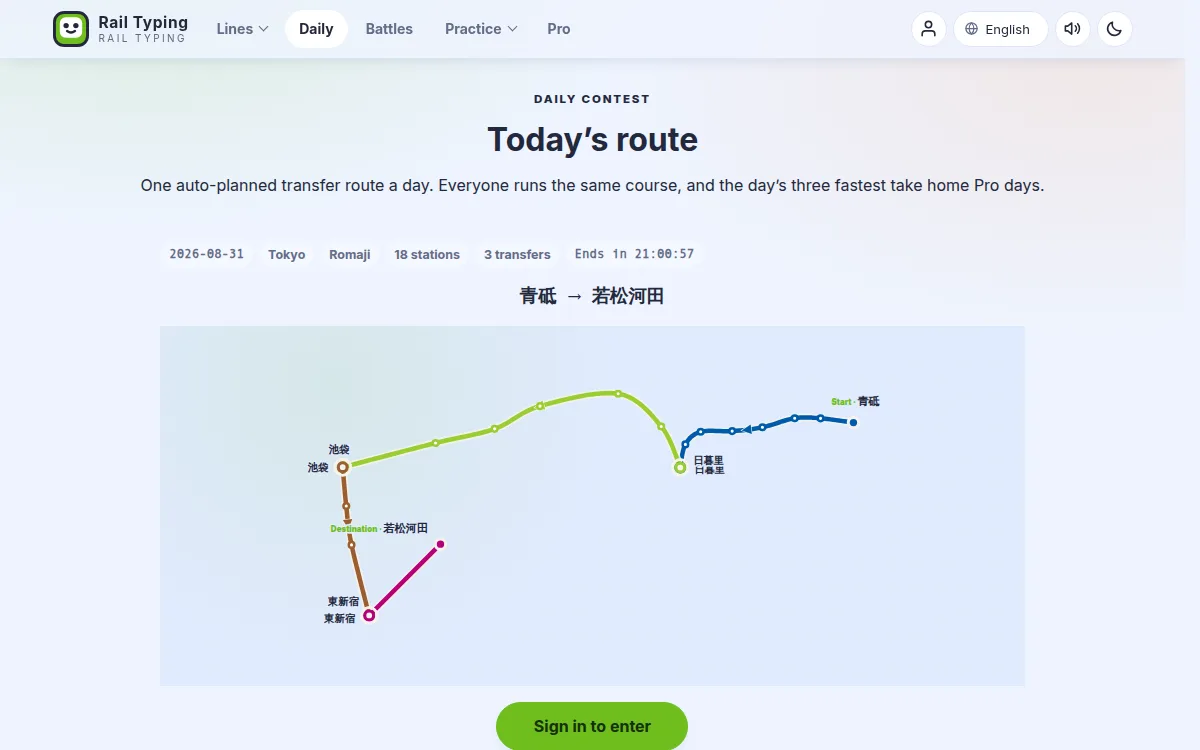
The route maps needed work too. Japanese station names are two to four glyphs wide, so labels could all sit on one side of the line without colliding. "King's Cross St. Pancras" is about six times wider than 新宿. Latin lines now alternate their labels left and right, which doubles the room each one has.
Where next
More Underground lines, once physical station identity lands and the branched lines become possible. And now that the model is city-neutral rather than Japan-shaped, the next city after that is a much smaller question than this one was.