Week of 24–30 August 2026. Five new lines, a contest that resets every night, and a romaji engine that stopped accepting keys nobody types.
A new route every day
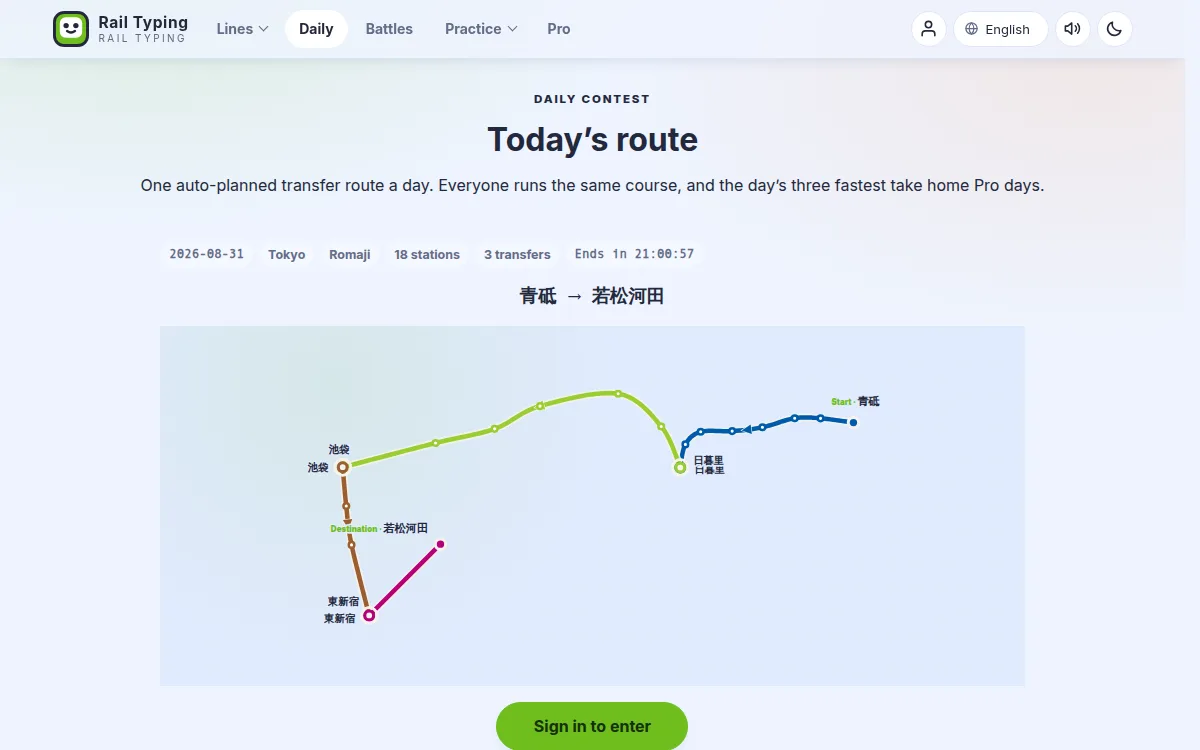
The daily contest opened on the 27th. One route, the same for everyone, replaced at UTC midnight.
It is not a single line. The route planner picks two stations in one city and plans across whatever lines it takes to get between them, so a contest run changes trains once or twice and asks for a dozen to two dozen station names in a row. Cities rotate through Tokyo, Osaka, Kyoto and Sapporo; the mode alternates between romaji and kana. The top three finishers get Pro — seven days, five, three — settled at 00:10 the next morning, with yesterday's podium on the page all day.
Kanji days are deliberately absent. Kanji mode needs a real IME, so a kanji contest would quietly shrink the field while paying out the same three prizes. London is out for a related reason: its lines are Latin-script, and mixing them in would mean some days ask for a different skill entirely.
Three decisions worth stating, because they are the kind you only notice when they are wrong:
A run you start at 23:58 still counts. Submissions are judged against the day the run began, not the clock when it ends. Rejecting a lap because the date rolled over mid-run would punish you for the calendar. Entries stay open until the prizes are actually handed out — which is why settlement is at 00:10 and not midnight.
You are told before you play, not after. The contest needs an account, and it refuses at the start of a run rather than at submission.
A contest run cannot touch anything else. It never sets a personal best, never earns a stamp, and never lands on a single line's leaderboard. The generated route carries a line id that deliberately does not exist in the registry, so there is no board for it to leak onto.
Route length is set per city rather than one band for everybody. Kyoto and Sapporo top out at twenty legs once a change of trains is required — measured by planning every station pair in both — so Tokyo's upper range simply does not exist there. Holding Kyoto to Tokyo's minimum would have left forty-two qualifying routes in the entire city, which starts repeating inside a year.
The home page carries the contest now too, with today's route and the current leader.
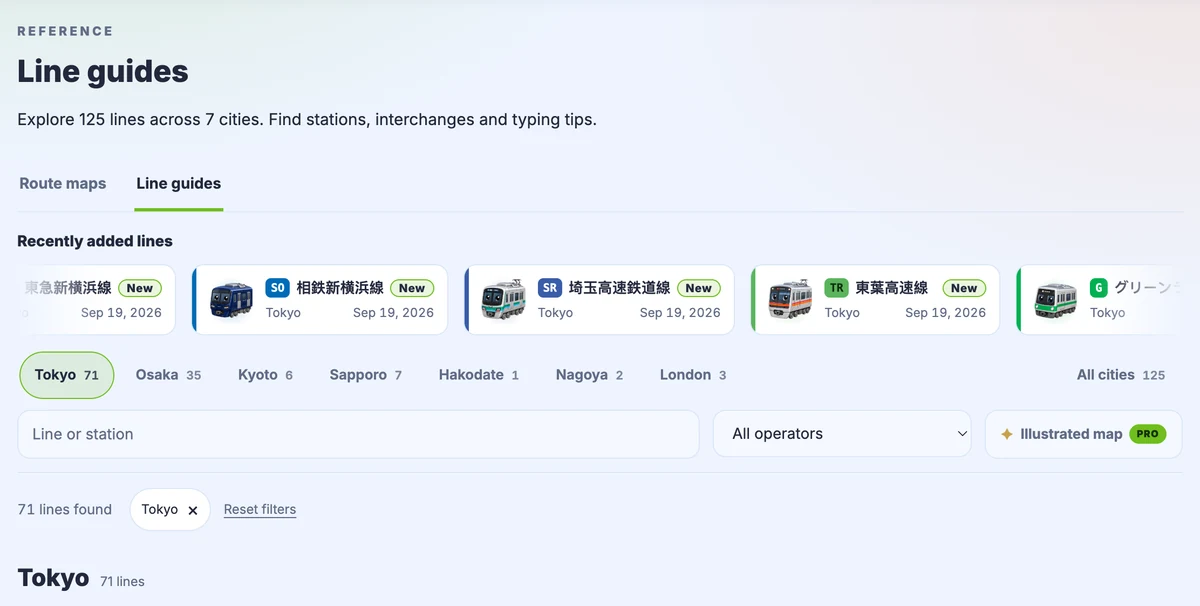
Five new lines
The Keio Inokashira Line — 17 stations, 渋谷 to 吉祥寺, 12.7 km — landed on the 25th, and the point of it is that it is not a smaller 京王線. It opened in 1933 as the Teito Electric Railway, an Odakyu affiliate, and became Keio's only through the wartime 大東急 and its breakup in 1948. It still runs on 1067 mm narrow gauge, alone among Keio's lines, against the 1372 mm horsecar gauge on the Keio side. The two networks share an operator and 明大前 and nothing else — no track connection at all, and no through service onto a subway at either end.
The Keisei Main Line — 42 stations, 京成上野 to 成田空港, 69.3 km — arrived on the 26th and is the first line here that leaves Tokyo for good: twelve stations, then the Edo River, then thirty more in Chiba. 京成 is 京 from 東京 and 成 from 成田, and the company was chartered in 1909 to carry pilgrims to 成田山新勝寺. A century later the far end became an international airport and the job did not change.
Two things about it show up directly in what you type. The 1931 renaming put 京成 in front of eleven stations at once, to tell them apart from the government line's. And the last two stops are signed in English rather than romanized — 空港第2ビル reads "Narita Airport Terminal 2·3" on the boards — so that is what the line displays, while the kana keeps the reading.
Three JR West lines out of Kyoto followed on the 28th. The Nara Line (21 stations to 奈良), the Sagano Line (16 stations west to 園部 — this is the way to Arashiyama), and the Biwako Line (23 stations, 75.4 km down the east shore of Lake Biwa, joining the JR Kyoto Line end to end at 京都).
Each stops where its name stops rather than where the railway does. 嵯峨野線 is a nickname JR West has used since 1988 for a stretch of the 山陰本線; the purple E carries on to 城崎温泉, but station numbers were only ever issued for these sixteen. Readings were checked against JR West's own station pages rather than derived from the kanji, which is how 木幡 came out こはた here — not the こわた of Keihan's 木幡, 281 metres away.
The romaji engine stopped accepting keys nobody types
Google and Microsoft's IMEs also map ca/ci/cu/ce/co, qu, yi and wu onto か/し/く/せ/こ/い/う, and the engine mirrored that. Nobody reaches for those to type Japanese, so in practice they only ever turned a typo into a silently correct keystroke: c is a viable prefix of cu, so a stray c on the く of とうちゃく was accepted, cost no accuracy, and the hint then rewrote itself to match — the sign read touchacushimasu, which is not a romanization of 到着します in any system. Read that as the game having the wrong reading and you would be reading it fairly.
wu had leaked somewhere else too. 新浦安 has been displaying shinwurayasu instead of shinnurayasu this entire time — the only ん followed by う in the collection, and it needed no mistyping at all to show up.
Kunrei-shiki stays. si/tu/sya/tya/hu/zi are a real system with real users and a display style on the setup screen. Every station's romaji was diffed across the whole collection: 新浦安 is the only thing that changed, at the same character count, so no board was reset.
Pro: a day ledger, and a face
Complimentary Pro used to be a single flag per source — one campaign, one grant, and a second award of the same kind was silently dropped. It is an append-only ledger now, and days add up: seven plus thirty is thirty-seven, where it used to be thirty. A balance that lapsed restarts from the new award rather than being back-charged for the months you were away.
What that pays for today: every new account gets seven days of Pro automatically, and every account that already existed was given a month. Your billing page now shows the whole history — what was granted, when, and from where — including anything that was later revoked, so a balance that shrank can explain itself.
Pro also became visible. It used to show in exactly one place, a pill inside an account tab. There is a PRO badge on the leaderboards now, and on your own avatar in the header. A gifted membership counts the same as a bought one.
Checkout is still closed, and for the same reason as last week: the pricing page is public because our payment provider reviews a live site before enabling an account.
Avatars on every board
Signed-in players have had a profile photo all along — it was in the header and in battle rooms, but never on the boards, which is the one place players actually look at each other. It is there now, on every public board, in the recent-runs strip and on the daily contest.
The privacy setting moved with it. "Show my name on the leaderboard", turned off, now hides your photo too — a picture next to a derived Rider XXXX would identify you anyway and make the alias theatre. The wording of that setting and the privacy policy both changed to say so.
The header lost three entries
The nav had accumulated one link per feature and had never been pruned. In English it needed about 741 px inside a 1120 px shell, which is roughly 20 px more than it had — and that overflow is what the tablet breakpoint had been quietly hiding, by dropping the nav onto a second row.
Browsing the network is one menu now: route maps, line guides, route planner. The practice tools are another. The daily contest and battles stay as direct links, because burying a feature that launched three days earlier would undo the launch. Measured after: 341 px in English, 396 px in Japanese, one row down to 940 px.
Adding a second dropdown forced two older bugs into the open — two menus could be open at once, and neither click-outside nor Escape closed anything. The single menu had simply stayed open until you clicked one of its own links.
Also
- "Browse every line" on the home page now goes to the route maps rather than the line index. The button promises every line and the maps page is the one that delivers them.
- The Inokashira train's livery was wrong, and the Keisei portrait shipped without being registered, so the line drew a placeholder badge while its artwork sat unused. Both fixed.
- The station-voice generator now paces itself. Gemini's free tier allows ten requests a minute and answers a refusal with a 17–25 second wait; the old retry backed off for two seconds and burned all four attempts against a window it could never outlast. It holds a shared slot gate now, so a pass with nothing to do still finishes in a fraction of a second.
Next week
The three JR West lines opened Kyoto's mainline side, and there is more of it. The daily contest has now paid out its first podiums, so the next few days are the first real test of the settlement clock.
See you next Sunday.