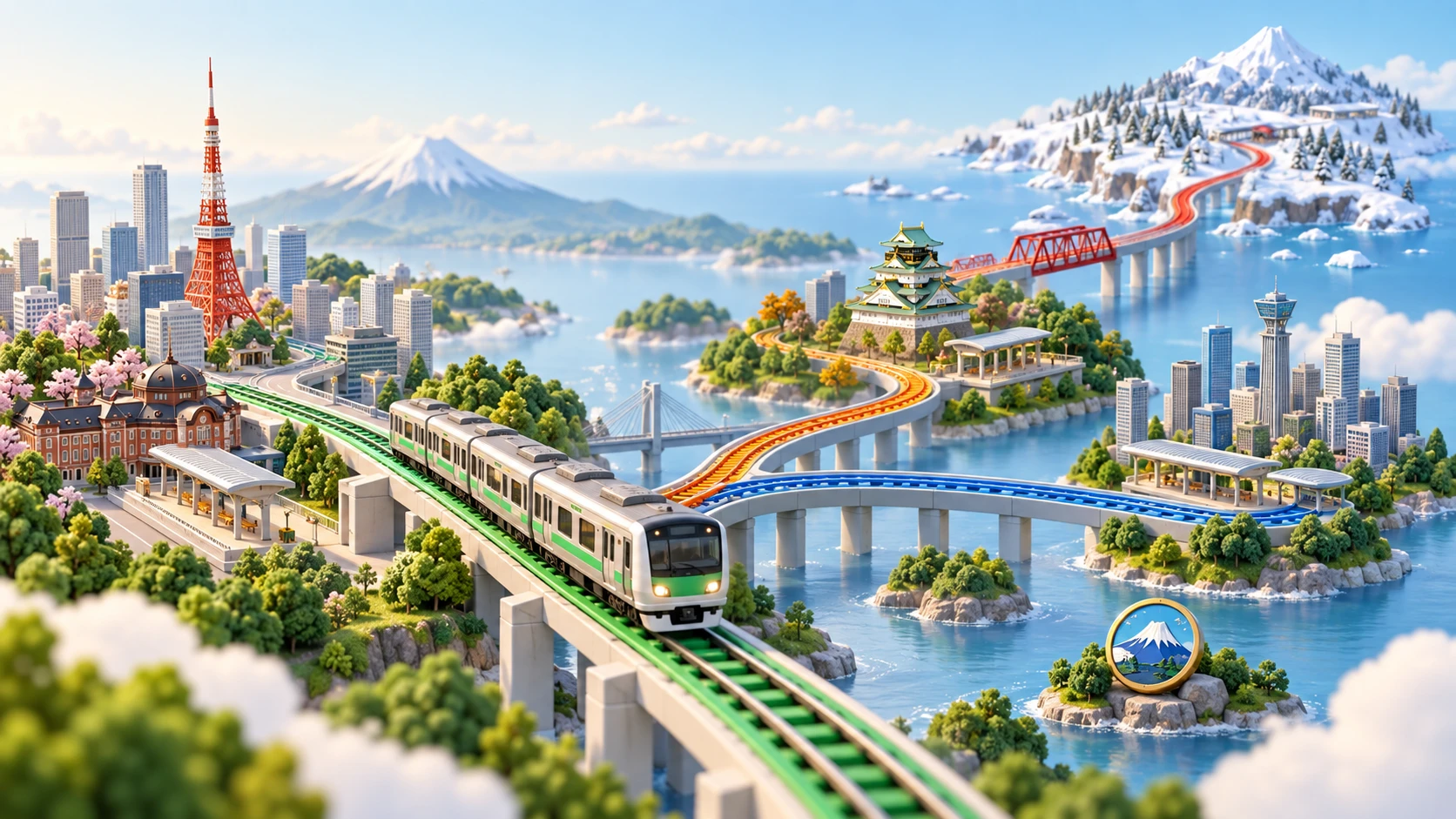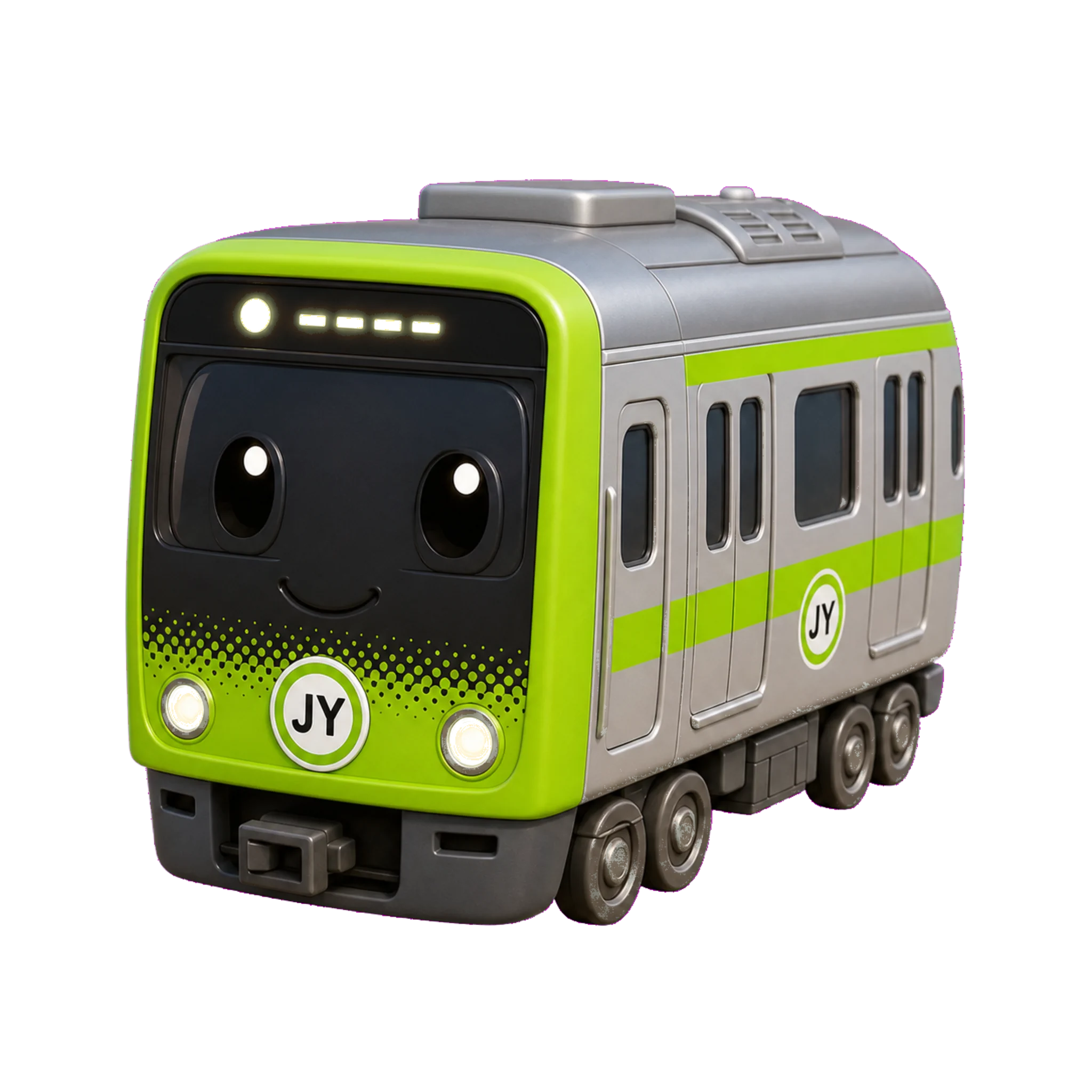
If Tokyo has a heartbeat, it is the JR Yamanote Line — a green loop of 30 stations that threads together nearly every major hub in the city. It is also the perfect first line to type in Tokyo Rail Typing, where a single run takes you all the way around the loop and back to where you began. This guide covers what the line is, how its two directions work, and why it makes such a satisfying typing challenge.
What the Yamanote Line is
The Yamanote Line (山手線) is a circular railway operated by JR East, and it is unusual among Tokyo lines because it has no true start or end — it just goes around. Its 30 stations form a continuous loop roughly 34.5 km long, and a full circuit takes about an hour on the real train.
In Tokyo Rail Typing, a Yamanote run mirrors that shape exactly: you pick a start station, choose a direction, and type your way all the way around until the train pulls back into the station you left from. It starts at the gate — the station you picked is the first name you type, and the last. One lap, 31 station names, one clean time at the end.
内回り and 外回り: the two directions
Because it is a loop, the Yamanote runs in two directions rather than "up" and "down":
- 内回り (uchi-mawari) — the inner loop, running counterclockwise on the map.
- 外回り (soto-mawari) — the outer loop, running clockwise on the map.
In the game, station order is 1-based and increases in the 内回り direction, so picking a direction simply decides which neighbor comes next. Trying both directions from the same start station gives you two genuinely different runs, since the sequence of names — and the rhythm of long and short ones — flips around.
The major hubs
The Yamanote's fame comes from the stations it strings together. These are some of the busiest interchanges in the world, and each doubles as a typing target:
- Tokyo (Tōkyō) — the shinkansen gateway and the eastern anchor of the loop.
- Shinjuku — the world's busiest station by passenger count.
- Shibuya — the scramble crossing, youth culture, and endless connections.
- Ikebukuro — the northern retail giant.
- Ueno — museums, the park, and gateway to the north.
- Shinagawa — a southern shinkansen and business hub.
Sprinkled between them are shorter, snappier names like Harajuku and Akihabara that give your fingers a breather. Almost every station here interchanges with countless other JR, Metro, and private lines, which is exactly why the loop is the backbone of getting around Tokyo.
Why it's the perfect first line to type
The Yamanote is the ideal place to learn the game for a few reasons:
- It's a loop, so every run is the same length and directly comparable — great for chasing a personal best.
- The names are familiar. Even if you have never been to Tokyo, you have probably heard of Shibuya and Shinjuku, which makes them easier to type from memory.
- There's a natural rhythm. Long hub names alternate with short ones, so you learn to steady your pace instead of sprinting flat out.
Type in romaji to start, switch to kana once the sounds feel natural, or push into kanji (IME) for the fastest ceiling — your personal best is tracked separately for each line and mode.
Take it for a lap
Every run reports your total time, CPM, WPM, accuracy, and per-station split times, so you can see exactly where you sped up or stumbled. Read the full line intro, then play the Yamanote Line and see how fast Tokyo goes by.
For more, see our guide to the perfect Yamanote lap, tips on learning station names, or browse all articles.