By now you can finish the loop — this is about finishing it fast. Chasing the perfect Yamanote lap is less about faster fingers and more about a smarter plan: reading your splits, front-loading momentum, and holding a rhythm across all 30 stations. Here is how to shave real seconds off your Yamanote lap time and finally beat your best time.
Let your splits pick your homework
The results screen is your coach. Once a lap is done, look past the headline WPM and study the per-station split times, because that is where every second hides:
- Sort your run in your head by feel, then confirm it against the numbers — find your three slowest stations.
- Long hub names (Shinjuku 新宿, Shibuya 渋谷, Takadanobaba 高田馬場, Nishi-Nippori 西日暮里) almost always cost the most.
- Compare the same station across several laps to see whether a fix actually stuck.
Reading typing splits turns one messy lap into a short, specific to-do list. Bring that list to /play/yamanote and work only on what is slow.
Drill the long names in groups
Short names like Ueno or Tabata rarely break your flow; the long hub names do. Instead of grinding whole laps, isolate the hard stretch:
- Start a run a station or two before your problem hub so you arrive at it warm.
- Repeat that cluster until the long name feels like one motion instead of a spelling test.
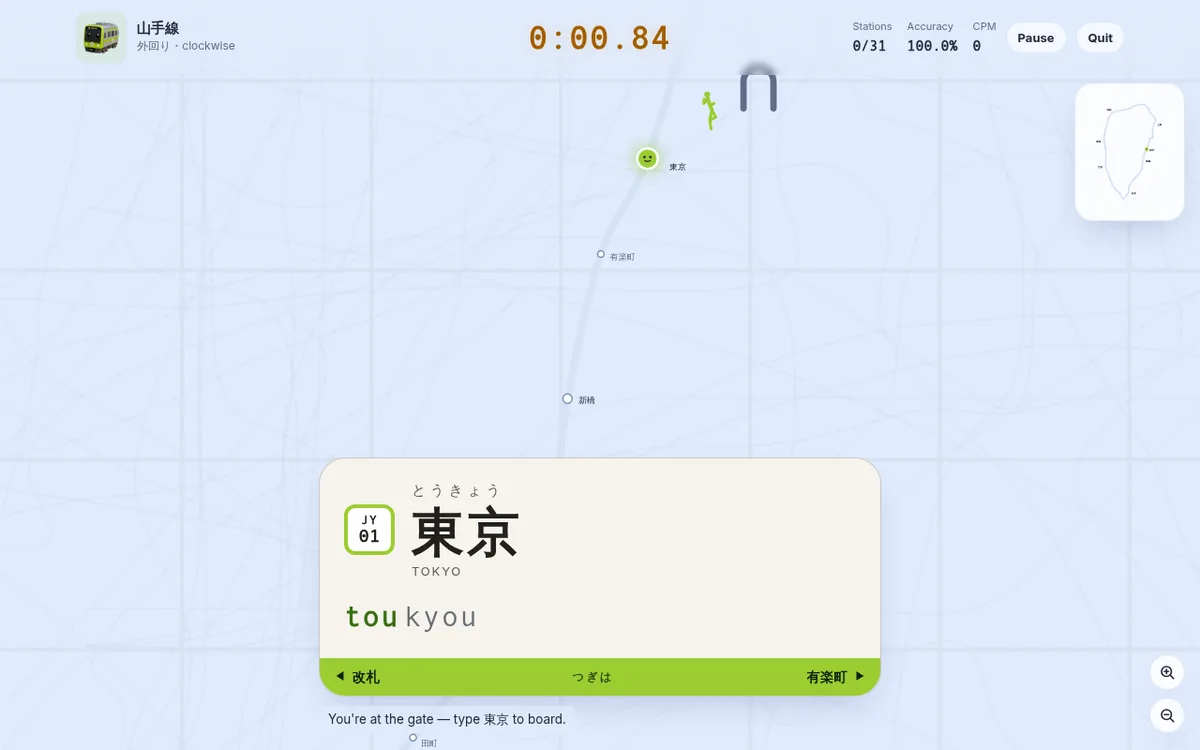
- Keep an eye on the line map so you know which giant is coming next — anticipation is half the speed.
The goal is that Shinjuku and Shibuya stop being spikes on your split chart and start looking like every other station.
Hold a rhythm, don't sprint and stall
The most common way to lose a lap is to sprint the easy first few stations, then blow up on the first long name. A steady tempo almost always beats a burst-and-brake pattern:
- Breathe on a fixed cadence — many players exhale as the train pulls into each station.
- Aim for one even pace you can hold for all 30 stops, not a pace you can only hold for five.
- Let the long names slow you slightly on purpose instead of forcing them and piling up rejected keys.
Remember: a wrong key is rejected, the train does not move, and there is no backspace. A mistyped key costs pure time, so a smooth clean lap will quietly outrun a frantic one.
Front-load momentum with start and direction
You choose your start station and direction (内回り / 外回り), and a smart choice sets the tone for the whole lap:
- Pick a start that puts a run of short, familiar names first, so you build confidence and speed before the first hub.
- Try both directions — the order the long names arrive in changes completely, and one will suit your hands better.
- Whatever you settle on, keep it consistent while chasing a record, since your personal best is tracked per line and per input mode. Comparing like with like is the only honest way to see improvement.
Push accuracy, not panic
Once your rhythm holds, the last gains come from tightening accuracy rather than mashing harder. Consistent clean keystrokes at 99% will beat a jittery burst that stalls every third station. If you want the biggest long-term ceiling, rebuild your best in Kanji (IME) mode — it feels slower at first but tops out fastest once mastered.
Two more reads before your next attempt: Improve your typing speed for the training drills behind these tactics, and the Yamanote line guide for the stations themselves. New here? Start with Getting started, or browse the rest of the blog. Now go improve that lap time — your best is only your best until the next run.