Tokyo has hundreds of stations, and to a newcomer the names blur together into a wall of unfamiliar sound and kanji. The good news is that station names are one of the most learnable things in Japanese — they repeat, they follow patterns, and they are attached to places you can picture. Here is how to learn Tokyo station names fast, and how typing them turns fuzzy recognition into instant recall.
Chunk by line, not by city
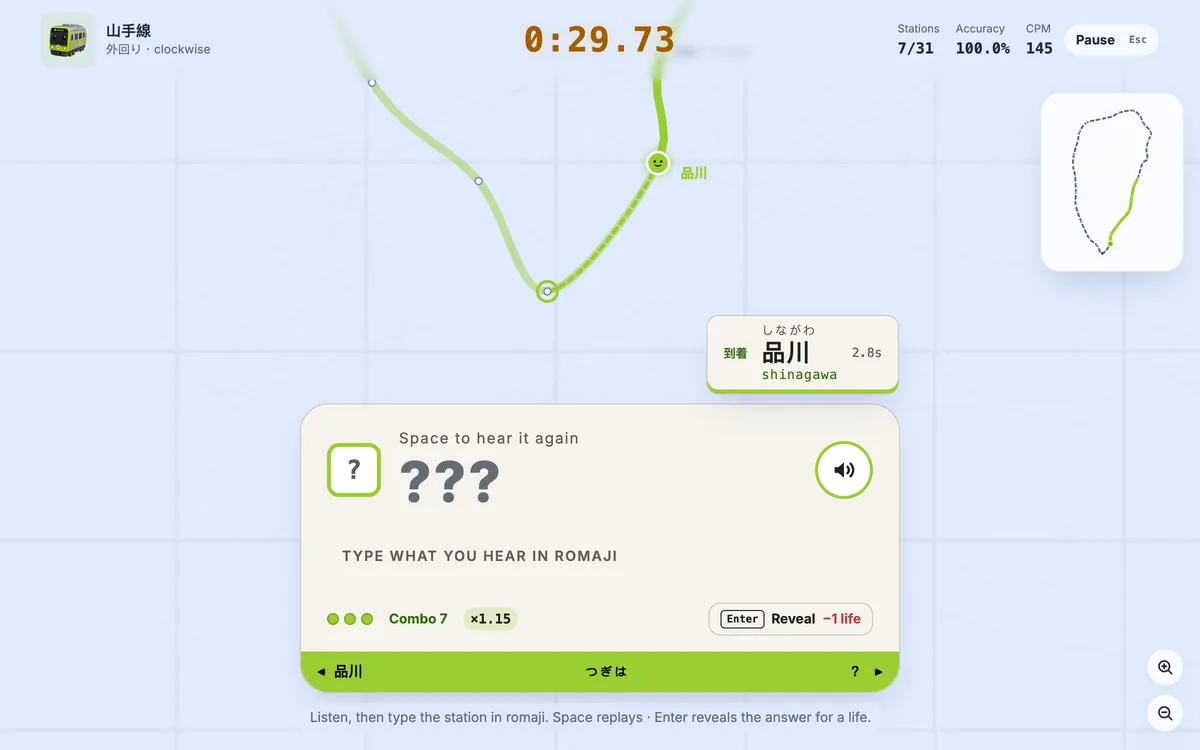
Trying to memorize Tokyo's stations as one giant list is hopeless. Break them into lines instead. A single line is a manageable set — the JR Yamanote Line is a 30-station loop, and once you know it, you own a mental map of central Tokyo.
- Group the stations by the line they sit on.
- Learn them in route order, the way you would actually ride them.
- Anchor a few landmark stations first (Tokyo, Shinjuku, Shibuya), then fill in the gaps between them.
Order is the secret weapon. When names live in a fixed sequence, each one cues the next, so recalling "Shibuya" pulls up "Ebisu" without effort.
Let the kanji tell you the meaning
Most Japanese place names are plain descriptions once you read the kanji, and meaning is far stickier than sound. This is exactly what makes the kanji IME mode easier — you are typing words, not memorizing noise.
- 新宿 Shinjuku — "new lodging," an old post-town waystation.
- 上野 Ueno — "upper field," the high ground north of the old city.
- 品川 Shinagawa — "goods river," a historic harbor and checkpoint.
- 渋谷 Shibuya — "bitter valley," and it really does sit in a bowl.
- 秋葉原 Akihabara — "field of autumn leaves," now anything but.
- 御茶ノ水 Ochanomizu — "the water for tea," from a shogun's favored well.
Once you see 新 = new, 野 = field, 谷 = valley, 川 = river, whole clusters of names decode themselves.
Use small mnemonics for the tricky ones
A handful of names resist logic and just need a hook. Build a quick image or story for each holdout — the sillier, the stickier — and you only have to do it once. Ochanomizu becomes "a river you could brew tea from"; Uguisudani becomes "the valley where the bush warbler sings." You will not need the crutch for long.
Turn recognition into recall by typing
Reading a name and producing it are two different skills. You can recognize "駒込" on a sign yet freeze when asked to type it. Repeated typing closes that gap: each keystroke forces active retrieval, and active retrieval is what actually builds memory.
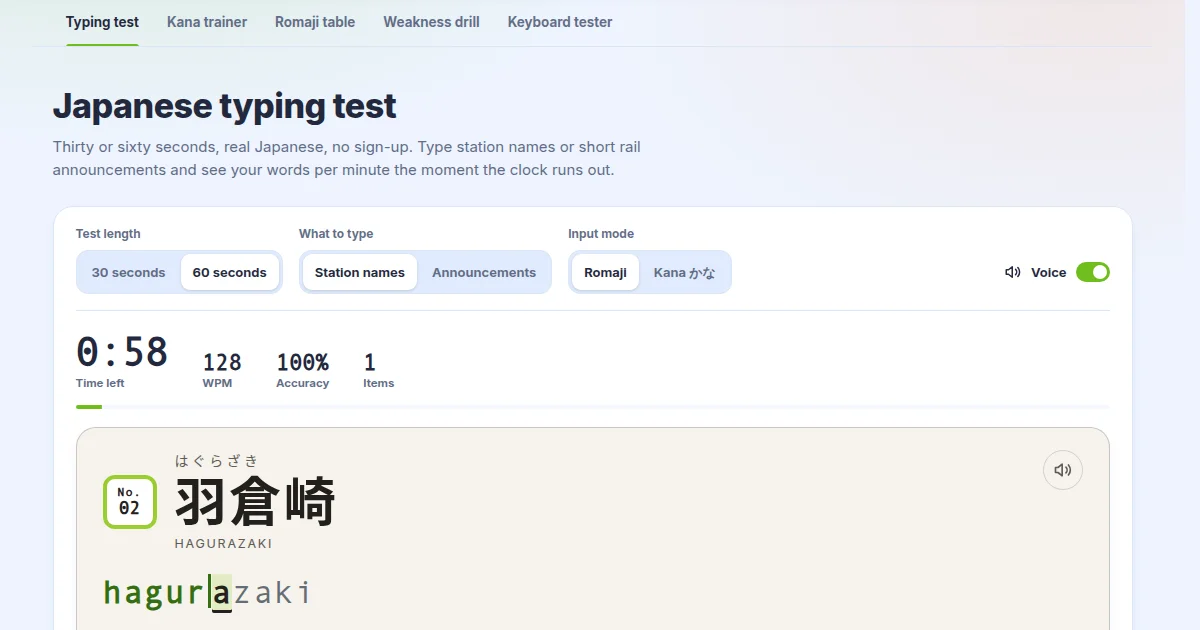
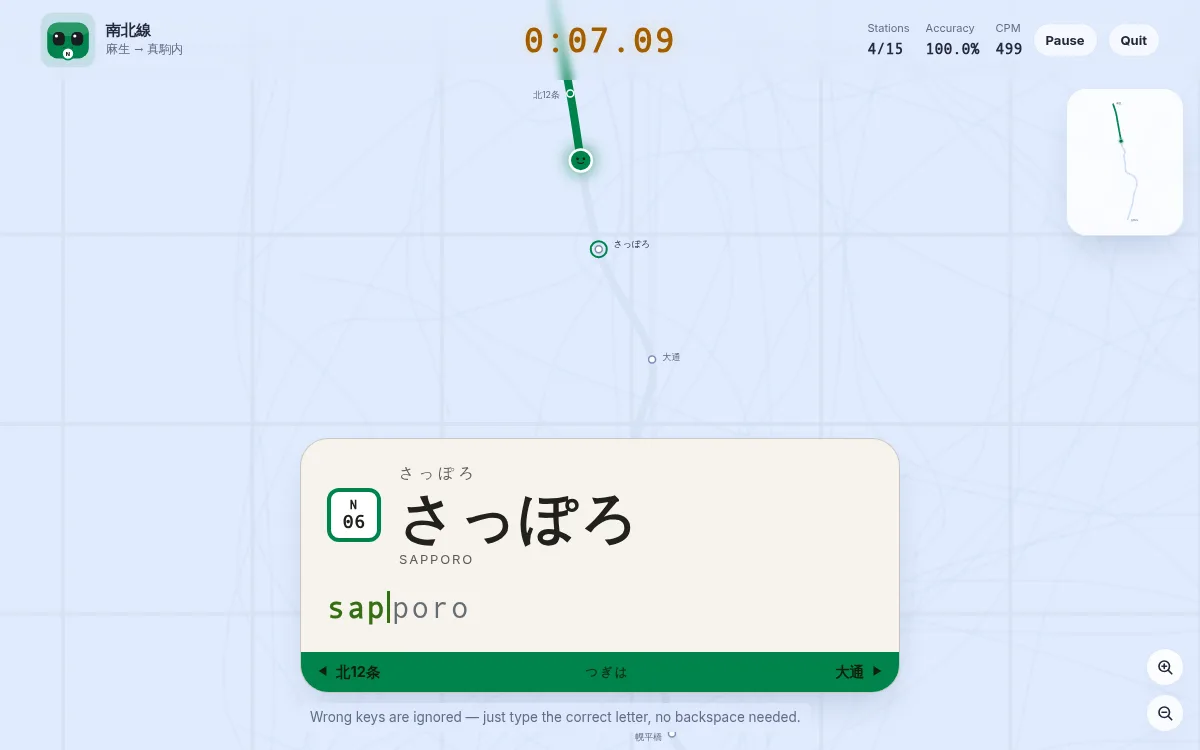
That is the whole point of Tokyo Rail Typing. You type each station's name to advance the train along your chosen line and direction until the route completes — so a single lap of the Yamanote is 30 reps of spaced, in-order practice.
- Romaji mode drills the sounds and Hepburn spelling.
- Kana mode links sound to the kana on the board.
- Kanji (IME) mode rewards knowing what the place names mean.
Target the names that slow you down
After every run you get your time, CPM, WPM, accuracy, and — most usefully — per-station splits. Those splits are a heat map of your weak spots: the stations where you hesitate are exactly the ones you have not truly learned yet.
- Read your splits and note the two or three slowest stops.
- Do a few short runs focused on that stretch of line.
- Watch those splits drop, then move on.
Pick a line and start a lap on /play/yamanote. If romaji spelling trips you up, keep the Hepburn romaji cheat sheet open, skim the Yamanote Line guide for the full station order, and browse more articles when you are ready for the next line.