Overview
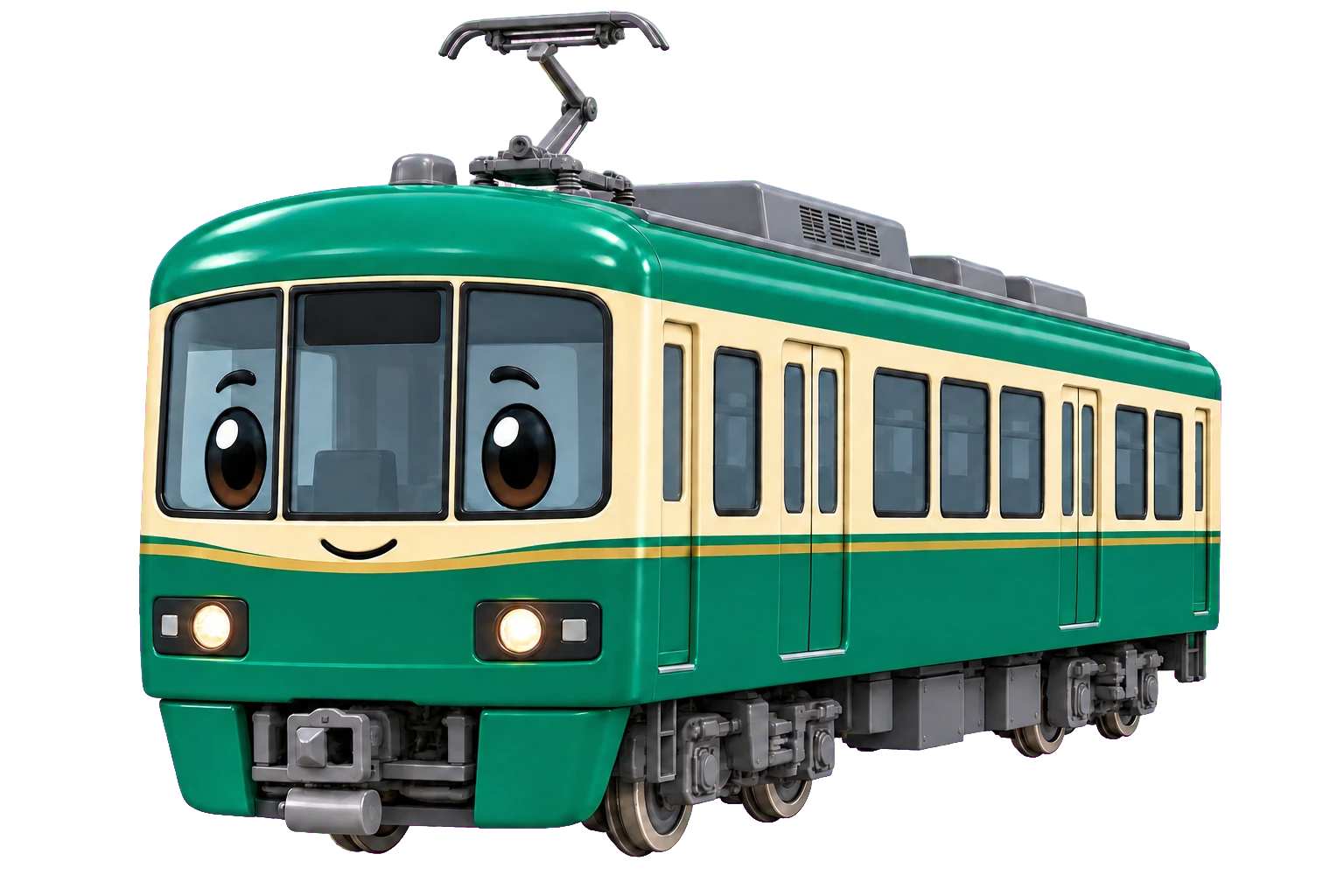
The Enoden (EN) — the Enoshima Electric Railway — runs 10.0 km from Fujisawa to Kamakura in 15 stations, and that is the whole railway: the company has no other line. It opened on 1 September 1902 as a tramway between Fujisawa and Katase, today's Enoshima, and reached Kamakura on 4 November 1910. It was only reclassified as a railway on 27 November 1945, and the tramway still shows in how it runs. The line is single track from end to end, so trains meet at five passing stations — Kugenuma, Enoshima, Inamuragasaki, Gokurakuji and Hase — and the short articulated two-car sets run coupled into fours for most of the day.
For a while it looked as though it might not survive at all. In the late 1960s, with car ownership climbing and riders falling away, closing the line was seriously discussed. It stayed open, and the accumulated deficit it had carried since 1975 was cleared in the accounts for 1989. Trains ran every 12 minutes from 1952 until the March 2023 timetable, which moved them to every 14. Since October 2019 the company has been a wholly owned subsidiary of Odakyu, whose Enoshima Line it meets at Fujisawa — but no train runs from one onto the other.
Along the route
From Fujisawa, alongside the JR and Odakyu stations, the line heads south through the houses of Fujisawa: Ishigami, Yanagikoji and Kugenuma come 0.6 to 0.7 km apart, then Shonan-Kaigan-Koen, then Enoshima. The island itself is a walk from here. Odakyu's Katase-Enoshima station is about 600 m away and the Shonan Monorail's Shonan-Enoshima sits just across Route 467, but they are separate stations and neither is a transfer in the game.
From the Ryukoji intersection just past Enoshima, the track runs down the middle of the prefectural road to Koshigoe, trains sharing the street with cars and people on foot. Koshigoe's platform is shorter than a four-car train, so the car at the Kamakura end keeps its doors shut. Then the sea opens up. At Kamakura-Koko-Mae the view from the platform is Sagami Bay and nothing else — the reason it was chosen for the Kanto 100 Stations in 1997 — and the level crossing beside it, drawn into the opening of Slam Dunk, has become a place fans travel to see.
The line follows the coast past Shichirigahama and Inamuragasaki, in places on the very edge of the road, then turns inland to Gokurakuji, where the depot sits beside the station, and through the brick tunnel finished in 1907 to Hase — the station for Kotoku-in's Great Buddha and for Hase-dera. Yuigahama and Wadazuka are just 0.3 km apart, and the line ends inside Kamakura station, where it has terminated since 1949; before that, its terminus was at Komachi.
Why play it
Fifteen stations and 10 km: the Enoden is a run you can finish in one breath, which is exactly why each trap counts. The station is 江ノ島 with a katakana ノ, not the 江の島 of the island or of the monorail's 湘南江の島, so in Kanji mode an IME's first suggestion can cost you. Three coast names — 七里ヶ浜, 稲村ヶ崎 and 由比ヶ浜 — are written with ヶ and read が, the same split as 富士見ヶ丘 on the Inokashira Line. 腰越 voices its 越 into こしごえ, 和田塚 ends in づか, which accepts zu or du, and the 鵠 in 鵠沼 is a character few people meet outside place names. The one name with real length, 湘南海岸公園 (しょうなんかいがんこうえん), comes at station 5. Near the end 鎌倉高校前 sets up 鎌倉, so you type "kamakura" twice before the train stops — and just before that, Hase is the shortest name on the line, two kana that are easy to overshoot if you are still carrying speed from the coast.
Line data
Everything below is derived from the station data the game runs on, so it always matches what you actually type on the 江ノ電 — all 15 stops of it.
- Operator
- Enoshima Electric Railway
- Line symbol
- EN
- Stations
- 15
- Shape
- Terminal to terminal
- Termini
- 藤沢 — 鎌倉
How much typing is this?
Typing every station name on this line takes 153 keystrokes, an average of 10.2 per station. The longest name is 湘南海岸公園 (shonan-kaigan-koen) at 19 keystrokes; the shortest is 長谷 (hase) at 4. Those counts come from running each name's kana through the game's own romaji engine, so they are what your fingers actually do — not the length of the printed spelling.
Along the way: 0 names contain a small っ, which doubles the next consonant; 1 contain a small ゃ, ゅ or ょ, where the engine accepts both the Hepburn and Kunrei spellings (sha or sya, shu or syu); and 1 end in ん, whose trailing n folds into whatever comes next rather than standing alone.
Where you can change trains
2 of the 15 stations on this line connect to another line in the game. Follow any symbol to that line's guide.
Every station on the line
All 15 stations in order, with the official station number, the name in kanji, the kana the typing is derived from, and its Hepburn romaji.
| # | No. | Station | Kana | Romaji |
|---|---|---|---|---|
| 1 | EN01 | 藤沢 | ふじさわ | fujisawa |
| 2 | EN02 | 石上 | いしがみ | ishigami |
| 3 | EN03 | 柳小路 | やなぎこうじ | yanagikoji |
| 4 | EN04 | 鵠沼 | くげぬま | kugenuma |
| 5 | EN05 | 湘南海岸公園 | しょうなんかいがんこうえん | shonan-kaigan-koen |
| 6 | EN06 | 江ノ島 | えのしま | enoshima |
| 7 | EN07 | 腰越 | こしごえ | koshigoe |
| 8 | EN08 | 鎌倉高校前 | かまくらこうこうまえ | kamakura-koko-mae |
| 9 | EN09 | 七里ヶ浜 | しちりがはま | shichirigahama |
| 10 | EN10 | 稲村ヶ崎 | いなむらがさき | inamuragasaki |
| 11 | EN11 | 極楽寺 | ごくらくじ | gokurakuji |
| 12 | EN12 | 長谷 | はせ | hase |
| 13 | EN13 | 由比ヶ浜 | ゆいがはま | yuigahama |
| 14 | EN14 | 和田塚 | わだづか | wadazuka |
| 15 | EN15 | 鎌倉 | かまくら | kamakura |