Overview
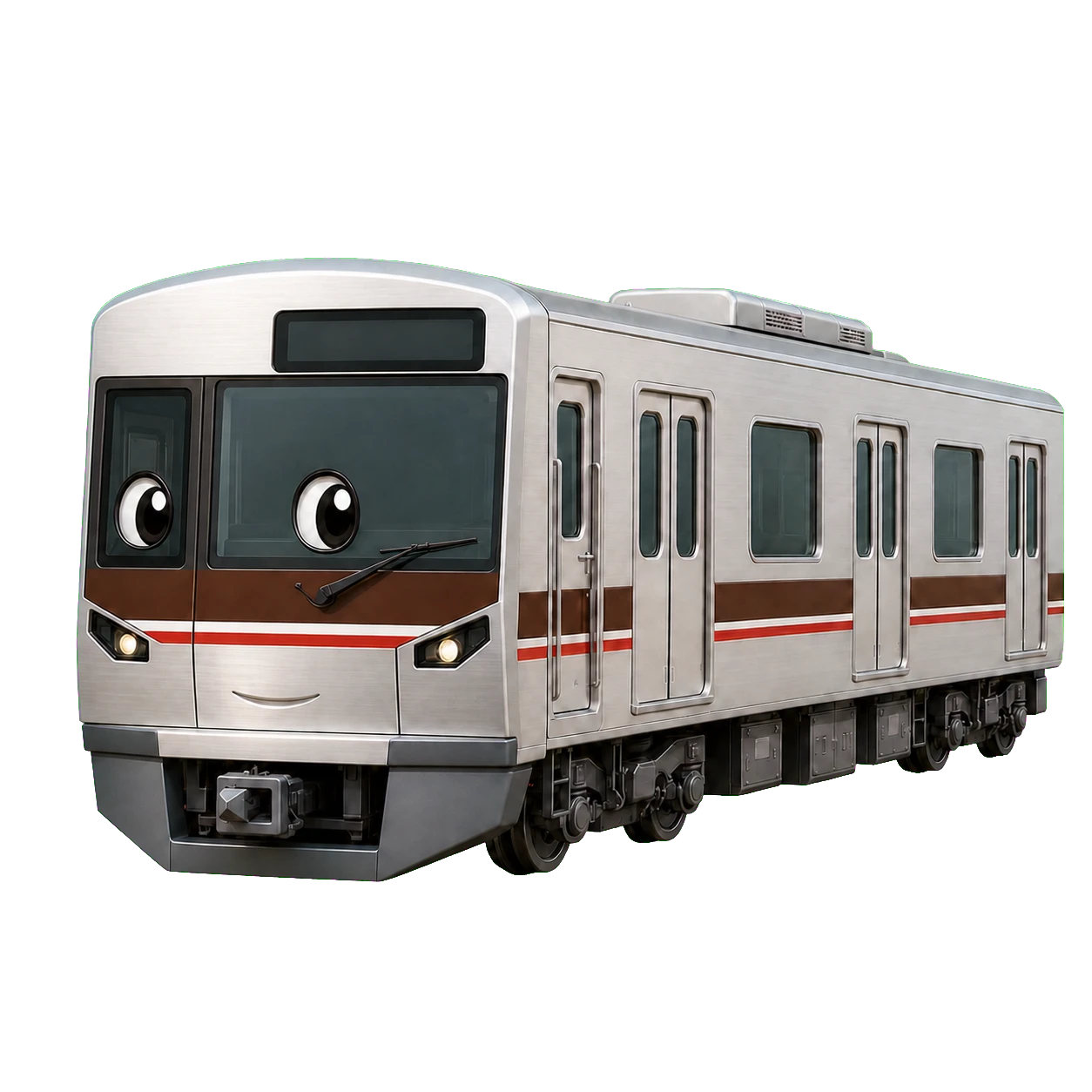
The Kita-Osaka Kyuko Line (M) is the Midosuji Line's northern end, run by somebody else: six stations, M06 to M11, and 8.4 km from Minoh-kayano down to Esaka, operated by Kita-Osaka Kyuko Railway, a 準大手私鉄 or semi-major private railway, backed by Hankyu and Osaka's public authorities. It opened on 24 February 1970 as the access railway for Expo '70, running through onto the Midosuji Line from its first day of service, and it still does so completely: the timetables are fused, nothing turns back at the boundary, and an ordinary service covers all 25 stations from Minoh-kayano to Nakamozu. The M numbers are one unbroken series counting down from Esaka at M11 to Minoh-kayano at M06, which is exactly why Osaka Metro's own Midosuji Line starts at M11 instead of M01. Expo traffic repaid the construction cost outright, and fares on the original section have been unusually low ever since. On paper the line is not even called this: the official name is 南北線, and 北大阪急行線 is simply what every sign, announcement and route map says instead.
Along the route
Minoh-kayano is new, opened on 23 March 2024 at the head of a 2.5 km extension, at grade beside the Kayano Chuo shopping district. Minoh-semba handai-mae is underground beneath a side road of the Shin-Midosuji, its 阪大前 being the Osaka University campus that moved there in 2021. Senri-chuo, the northern terminal for the line's first fifty-four years and the Osaka Monorail interchange, only took its permanent site when the branch out to the Expo grounds closed in September 1970 — that trackbed now carries the Chugoku Expressway's inbound carriageway, and its tunnel survives as a materials store. Beyond it the line crosses Senri New Town to Momoyamadai, the depot on the west side of the tracks, and Ryokuchi-koen, an infill station of 1975 named for the Hattori Ryokuchi park, with the company's head office above the platforms. Esaka closes the line: southern terminal, legal starting point, and a station Osaka Metro owns and staffs, so its boards are Osaka Metro's rather than the operator's. The whole run is arrow-straight across the Senri Hills, mostly in the median of the Shin-Midosuji expressway, and has no level crossings at all.
Why play it
Six names, and they split hard: Esaka is esaka, five keystrokes, while Minoh-semba handai-mae is minoosenbahandaimae, nineteen — the longest name on the line, and most of the reason a six-stop run here is not a formality. Both Minoh stations are signed with Hepburn's oh for the long お of 箕面, so the board's Minoh-kayano is minookayano under the fingers, and the same board's semba is typed senba: read the kana, not the roman. Long vowels do the rest, Senri-chuo coming out as senrichuuou and Ryokuchi-koen as ryokuchikouenn, with a trailing ん that wants its second n. Otherwise there is nothing to trip over: no sokuon anywhere, only two names with a small kana, and every reading the obvious one — 船場 is せんば, not ふなば. Learn the long one, and the other five are 52 keystrokes of pure speed.
Line data
Everything below is derived from the station data the game runs on, so it always matches what you actually type on the 北大阪急行線 — all 6 stops of it.
- Operator
- Kita-Osaka Kyuko Railway
- Line symbol
- M
- Stations
- 6
- Shape
- Terminal to terminal
- Termini
- 箕面萱野 — 江坂
How much typing is this?
Typing every station name on this line takes 71 keystrokes, an average of 11.8 per station. The longest name is 箕面船場阪大前 (minoo-semba-handai-mae) at 19 keystrokes; the shortest is 江坂 (esaka) at 5. Those counts come from running each name's kana through the game's own romaji engine, so they are what your fingers actually do — not the length of the printed spelling.
Along the way: 0 names contain a small っ, which doubles the next consonant; 2 contain a small ゃ, ゅ or ょ, where the engine accepts both the Hepburn and Kunrei spellings (sha or sya, shu or syu); and 1 end in ん, whose trailing n folds into whatever comes next rather than standing alone.
Where you can change trains
2 of the 6 stations on this line connect to another line in the game. Follow any symbol to that line's guide.
- 千里中央OM 大阪モノレール本線
- 江坂M 御堂筋線
Every station on the line
All 6 stations in order, with the official station number, the name in kanji, the kana the typing is derived from, and its Hepburn romaji.
| # | No. | Station | Kana | Romaji |
|---|---|---|---|---|
| 1 | M06 | 箕面萱野 | みのおかやの | minoo-kayano |
| 2 | M07 | 箕面船場阪大前 | みのおせんばはんだいまえ | minoo-semba-handai-mae |
| 3 | M08 | 千里中央 | せんりちゅうおう | senri-chuo |
| 4 | M09 | 桃山台 | ももやまだい | momoyamadai |
| 5 | M10 | 緑地公園 | りょくちこうえん | ryokuchi-koen |
| 6 | M11 | 江坂 | えさか | esaka |