Overview
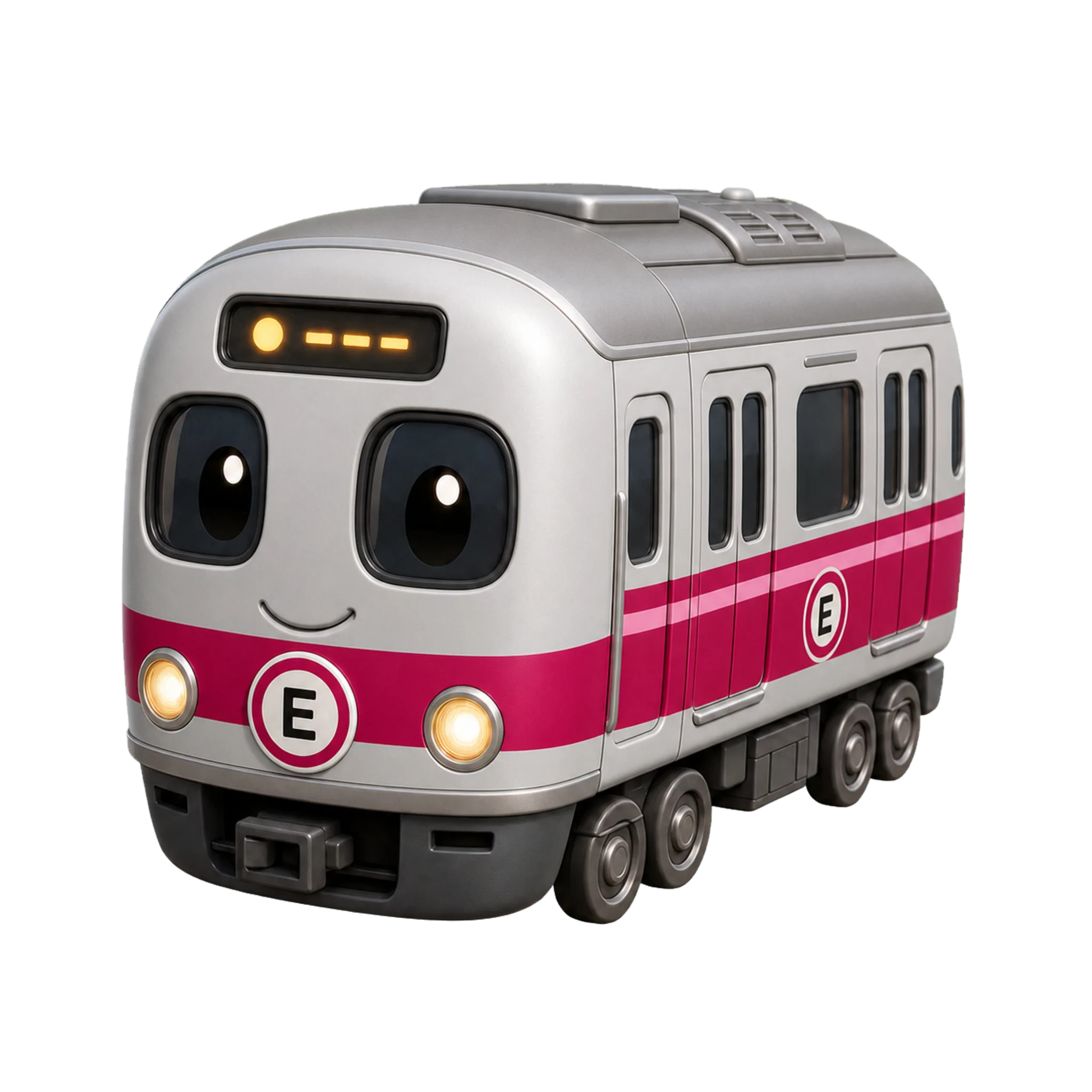
The Oedo Line (E) links Shinjuku-nishiguchi and Hikarigaoka over about 40.7 km and 38 stations — Toei's longest line, and the deepest subway in all of Tokyo. Its magenta trains trace a giant "6"-shaped loop.
Depth is its defining feature and its curse. By the time it was built in the 1990s, every shallow route under central Tokyo was taken, so the Oedo Line went under everything else — Roppongi's platforms sit about 42 metres down, the deepest in the country. It uses linear-motor propulsion and a smaller tunnel bore to keep the excavation affordable, which is why the trains look and sound different from every other line in Tokyo.
Along the route
The line passes Roppongi, Ryogoku, and Tsukishima, tracing nearly a full loop around central Tokyo before stretching out to Hikarigaoka near Nerima. Few lines in the game carry more stations, and some of its platforms sit deep enough to need genuinely long escalators.
Being late has advantages. Because the Oedo Line was drawn after every other line existed, it fills the gaps between them: Kiyosumi-shirakawa, Ushigome-yanagicho, Wakamatsu-kawada, Akabanebashi — neighbourhoods that had no station at all until 2000. If you want to see the parts of central Tokyo that tourism has not reached, this is the line that stops there.
Where the typing gets hard
Thirty-eight stations, 459 keystrokes, an average of 12.1 per stop. Both numbers are the highest in this guide by a wide margin: the Oedo Line asks for nearly twice the Yamanote's total keystrokes, and its average station name is 45% longer.
The names are long because they are compounds of compounds. Nishi-shinjuku-gochome (nishishinjukugochoume) is 21 keystrokes — the longest station name on the line. Ochiai-minami-nagasaki (ochiaiminaminagasaki) is 20. Then four names at 18: Shinjuku-nishiguchi, Ushigome-yanagicho, Ushigome-kagurazaka and Kokuritsu-kyogijo.
Thirteen stations carry a small ゃ/ゅ/ょ, three end in ん, and two carry a sokuon (Roppongi and Aoyama-itchome). There is no relief stretch: the shortest name on the whole line is Nakai at five keystrokes, and it is one station out of thirty-eight.
The two Ushigome stations are the specific hazard. Ushigome-yanagicho and Ushigome-kagurazaka are adjacent, both 18 keystrokes, both starting ushigome — nine identical characters before they diverge. Typing the wrong second half is the single most common Oedo mistake.
How to practise it
Treat it as a distance event, not a sprint. A full Oedo run takes most players two to three times as long as a Yamanote loop, and the mistake almost everyone makes is opening at Yamanote pace and losing accuracy around stop 20.
Learn the run in segments. The Ushigome pair, the Nishi-shinjuku-gochome / Tochomae stretch, and Ochiai-minami-nagasaki are where runs are lost — practise those names on their own and the rest of the line takes care of itself.
Despite the "6" shape on the map, this is a linear line in the game, so every run covers all 38 stations terminal to terminal. There is no shortcut and no partial course: finishing it at all is an achievement, and finishing it clean is the real test in this game.
Why play it
At 38 stations, this is one of the longest runs in the game — the ultimate test of endurance and focus, and prime territory for chasing a marathon-length personal best.
Line data
Everything below is derived from the station data the game runs on, so it always matches what you actually type on the 大江戸線 — all 38 stops of it.
- Operator
- Toei Subway
- Line symbol
- E
- Stations
- 38
- Shape
- Terminal to terminal
- Termini
- 新宿西口 — 光が丘
How much typing is this?
Typing every station name on this line takes 459 keystrokes, an average of 12.1 per station. The longest name is 西新宿五丁目 (nishi-shinjuku-gochome) at 21 keystrokes; the shortest is 中井 (nakai) at 5. Those counts come from running each name's kana through the game's own romaji engine, so they are what your fingers actually do — not the length of the printed spelling.
Along the way: 2 names contain a small っ, which doubles the next consonant; 14 contain a small ゃ, ゅ or ょ, where the engine accepts both the Hepburn and Kunrei spellings (sha or sya, shu or syu); and 3 end in ん, whose trailing n folds into whatever comes next rather than standing alone.
Where you can change trains
22 of the 38 stations on this line connect to another line in the game. Follow any symbol to that line's guide.
- 東新宿F 副都心線
- 飯田橋T 東西線Y 有楽町線N 南北線JB 中央・総武線各駅停車
- 春日I 三田線
- 本郷三丁目M 丸ノ内線
- 新御徒町TX つくばエクスプレス
- 蔵前A 浅草線
- 両国JB 中央・総武線各駅停車
- 森下S 新宿線
- 清澄白河Z 半蔵門線
- 門前仲町T 東西線
- 月島Y 有楽町線
- 汐留U ゆりかもめ
- 大門A 浅草線
- 麻布十番N 南北線
- 六本木H 日比谷線
- 青山一丁目G 銀座線Z 半蔵門線
- 代々木JY 山手線JB 中央・総武線各駅停車
- 新宿JY 山手線M 丸ノ内線S 新宿線JC 中央線JB 中央・総武線各駅停車JS 湘南新宿ラインJA 埼京線KO 京王線OH 小田原線SS 新宿線
- 中野坂上M 丸ノ内線
- 東中野JB 中央・総武線各駅停車
- 中井SS 新宿線
- 練馬SI 西武池袋線
Marked with a star: 新宿 — the major interchanges, which the maps always label and the game marks with a heavier arrival stamp.
Every station on the line
All 38 stations in order, with the official station number, the name in kanji, the kana the typing is derived from, and its Hepburn romaji.
| # | No. | Station | Kana | Romaji |
|---|---|---|---|---|
| 1 | E01 | 新宿西口 | しんじゅくにしぐち | shinjuku-nishiguchi |
| 2 | E02 | 東新宿 | ひがししんじゅく | higashi-shinjuku |
| 3 | E03 | 若松河田 | わかまつかわだ | wakamatsu-kawada |
| 4 | E04 | 牛込柳町 | うしごめやなぎちょう | ushigome-yanagicho |
| 5 | E05 | 牛込神楽坂 | うしごめかぐらざか | ushigome-kagurazaka |
| 6 | E06 | 飯田橋 | いいだばし | iidabashi |
| 7 | E07 | 春日 | かすが | kasuga |
| 8 | E08 | 本郷三丁目 | ほんごうさんちょうめ | hongo-sanchome |
| 9 | E09 | 上野御徒町 | うえのおかちまち | ueno-okachimachi |
| 10 | E10 | 新御徒町 | しんおかちまち | shin-okachimachi |
| 11 | E11 | 蔵前 | くらまえ | kuramae |
| 12 | E12 | 両国 | りょうごく | ryogoku |
| 13 | E13 | 森下 | もりした | morishita |
| 14 | E14 | 清澄白河 | きよすみしらかわ | kiyosumi-shirakawa |
| 15 | E15 | 門前仲町 | もんぜんなかちょう | monzen-nakacho |
| 16 | E16 | 月島 | つきしま | tsukishima |
| 17 | E17 | 勝どき | かちどき | kachidoki |
| 18 | E18 | 築地市場 | つきじしじょう | tsukijishijo |
| 19 | E19 | 汐留 | しおどめ | shiodome |
| 20 | E20 | 大門 | だいもん | daimon |
| 21 | E21 | 赤羽橋 | あかばねばし | akabanebashi |
| 22 | E22 | 麻布十番 | あざぶじゅうばん | azabu-juban |
| 23 | E23 | 六本木 | ろっぽんぎ | roppongi |
| 24 | E24 | 青山一丁目 | あおやまいっちょうめ | aoyama-itchome |
| 25 | E25 | 国立競技場 | こくりつきょうぎじょう | kokuritsu-kyogijo |
| 26 | E26 | 代々木 | よよぎ | yoyogi |
| 27 | E27 | 新宿 | しんじゅく | shinjuku |
| 28 | E28 | 都庁前 | とちょうまえ | tochomae |
| 29 | E29 | 西新宿五丁目 | にししんじゅくごちょうめ | nishi-shinjuku-gochome |
| 30 | E30 | 中野坂上 | なかのさかうえ | nakano-sakaue |
| 31 | E31 | 東中野 | ひがしなかの | higashi-nakano |
| 32 | E32 | 中井 | なかい | nakai |
| 33 | E33 | 落合南長崎 | おちあいみなみながさき | ochiai-minami-nagasaki |
| 34 | E34 | 新江古田 | しんえごた | shin-egota |
| 35 | E35 | 練馬 | ねりま | nerima |
| 36 | E36 | 豊島園 | としまえん | toshimaen |
| 37 | E37 | 練馬春日町 | ねりまかすがちょう | nerima-kasugacho |
| 38 | E38 | 光が丘 | ひかりがおか | hikarigaoka |