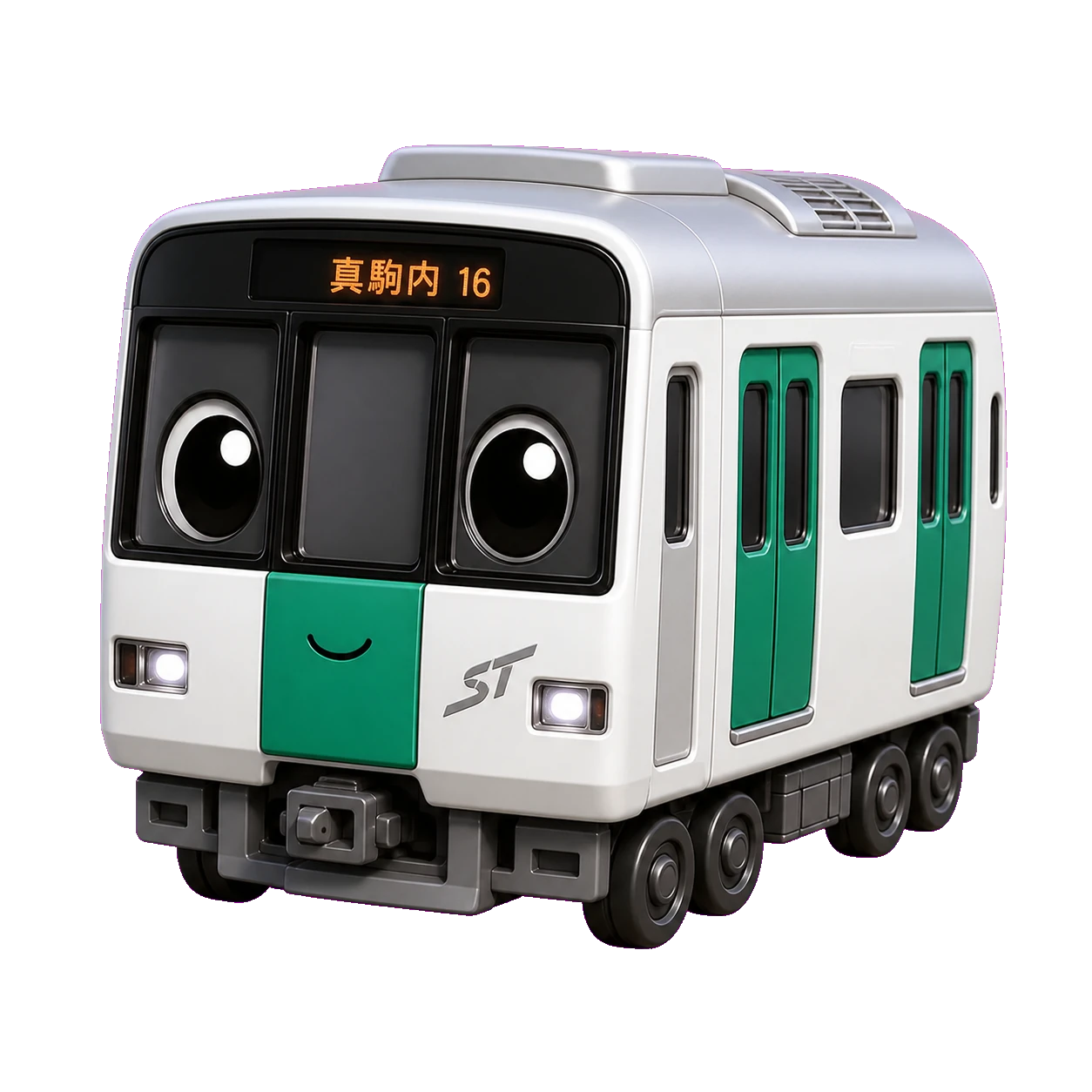
Overview
The Namboku Line (N) is Sapporo's first subway, opened on 16 December 1971, about six weeks before the Winter Olympics arrived in February 1972 — which is what got it built at all. Its 16 stations run 14.3 km from Asabu in the north down to Makomanai, 27.5 minutes end to end. There are no steel rails anywhere on it: the trains ride on rubber tyres and are steered by a single guide rail down the centre of the track, an idea brought back from the Paris Métro and rearranged enough to earn its own name, the "Sapporo method". It is also the only one of the three that takes its current from a third rail rather than overhead wire.
Along the route
Asabu is a major bus terminal and the busiest station on the network that isn't an interchange. From there the line drops south through the numbered grid — Kita sanjuyo jo, Kita nijuyo jo, Kita juhachi jo, Kita juni jo, past the Hokkaido University campus — into Sapporo, then Odori, the only station where all three lines meet, and Susukino, the largest entertainment district north of Tokyo. Nakajima koen has the park; Horohira bashi crosses the Toyohira River. Then the surprise. The 4.5 km from just south of Hiragishi to Makomanai runs elevated — the only stretch of Sapporo subway that ever sees daylight — on the abandoned right-of-way of the Jozankei Railway, which the city bought when that line closed, and it is roofed for its entire length in a snow shelter, because Sapporo gets nearly five metres of snow a season.
Why play it
The 北◯条 stations look like a counting exercise and aren't one. 34 and 24 both come out as …よじょう — Kita sanjuyo jo, Kita nijuyo jo, with 四 read yo — while 18 and 12 spell themselves out in full as じゅうはちじょう and じゅうにじょう. Four stations in a row, one pattern break, and the digits give you no warning. After that the line is gentler. Sapporo is written さっぽろ rather than 札幌, to keep it apart from JR's station next door, and its doubled p is the only sokuon on the whole line. The last thing to watch for is Hiragishi and Minami Hiragishi arriving back to back near the end of the run, by which point you have stopped reading carefully.
Line data
Everything below is derived from the station data the game runs on, so it always matches what you actually type on the 南北線 — all 16 stops of it.
- Operator
- Sapporo Municipal Subway
- Line symbol
- N
- Stations
- 16
- Shape
- Terminal to terminal
- Termini
- 麻生 — 真駒内
How much typing is this?
Typing every station name on this line takes 172 keystrokes, an average of 10.8 per station. The longest name is 北34条 (kita-sanjuyo-jo) at 15 keystrokes; the shortest is 麻生 (asabu) at 5. Those counts come from running each name's kana through the game's own romaji engine, so they are what your fingers actually do — not the length of the printed spelling.
Along the way: 1 names contain a small っ, which doubles the next consonant; 4 contain a small ゃ, ゅ or ょ, where the engine accepts both the Hepburn and Kunrei spellings (sha or sya, shu or syu); and 1 end in ん, whose trailing n folds into whatever comes next rather than standing alone.
Where you can change trains
5 of the 16 stations on this line connect to another line in the game. Follow any symbol to that line's guide.
Every station on the line
All 16 stations in order, with the official station number, the name in kanji, the kana the typing is derived from, and its Hepburn romaji.
| # | No. | Station | Kana | Romaji |
|---|---|---|---|---|
| 1 | N01 | 麻生 | あさぶ | asabu |
| 2 | N02 | 北34条 | きたさんじゅうよじょう | kita-sanjuyo-jo |
| 3 | N03 | 北24条 | きたにじゅうよじょう | kita-nijuyo-jo |
| 4 | N04 | 北18条 | きたじゅうはちじょう | kita-juhachi-jo |
| 5 | N05 | 北12条 | きたじゅうにじょう | kita-juni-jo |
| 6 | N06 | さっぽろ | さっぽろ | sapporo |
| 7 | N07 | 大通 | おおどおり | odori |
| 8 | N08 | すすきの | すすきの | susukino |
| 9 | N09 | 中島公園 | なかじまこうえん | nakajima-koen |
| 10 | N10 | 幌平橋 | ほろひらばし | horohira-bashi |
| 11 | N11 | 中の島 | なかのしま | nakanoshima |
| 12 | N12 | 平岸 | ひらぎし | hiragishi |
| 13 | N13 | 南平岸 | みなみひらぎし | minami-hiragishi |
| 14 | N14 | 澄川 | すみかわ | sumikawa |
| 15 | N15 | 自衛隊前 | じえいたいまえ | jieitai-mae |
| 16 | N16 | 真駒内 | まこまない | makomanai |