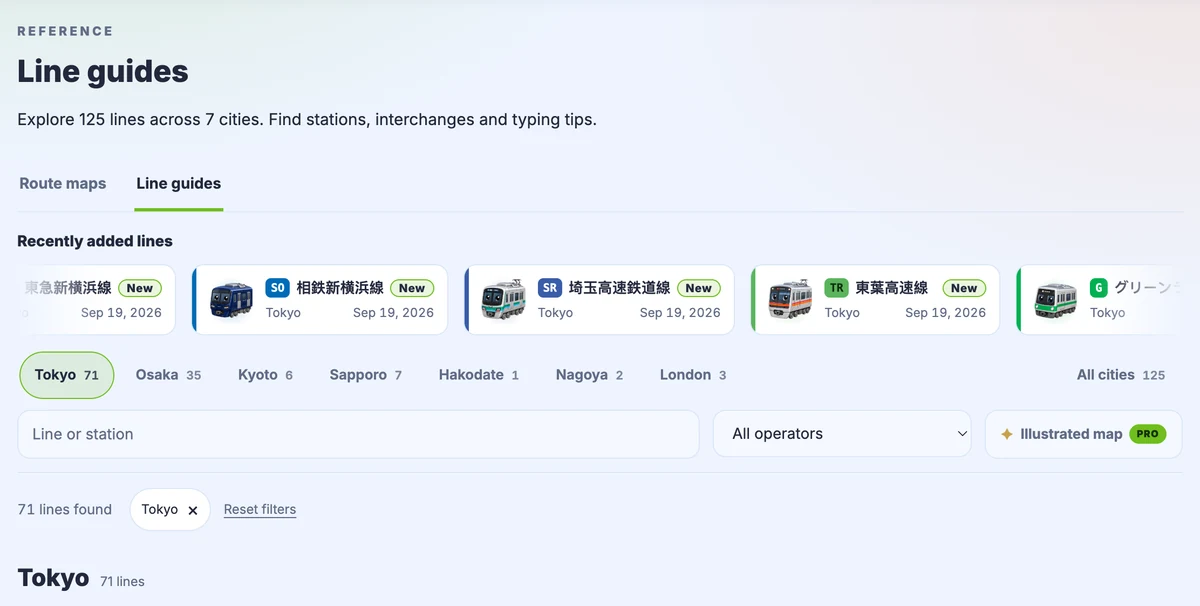
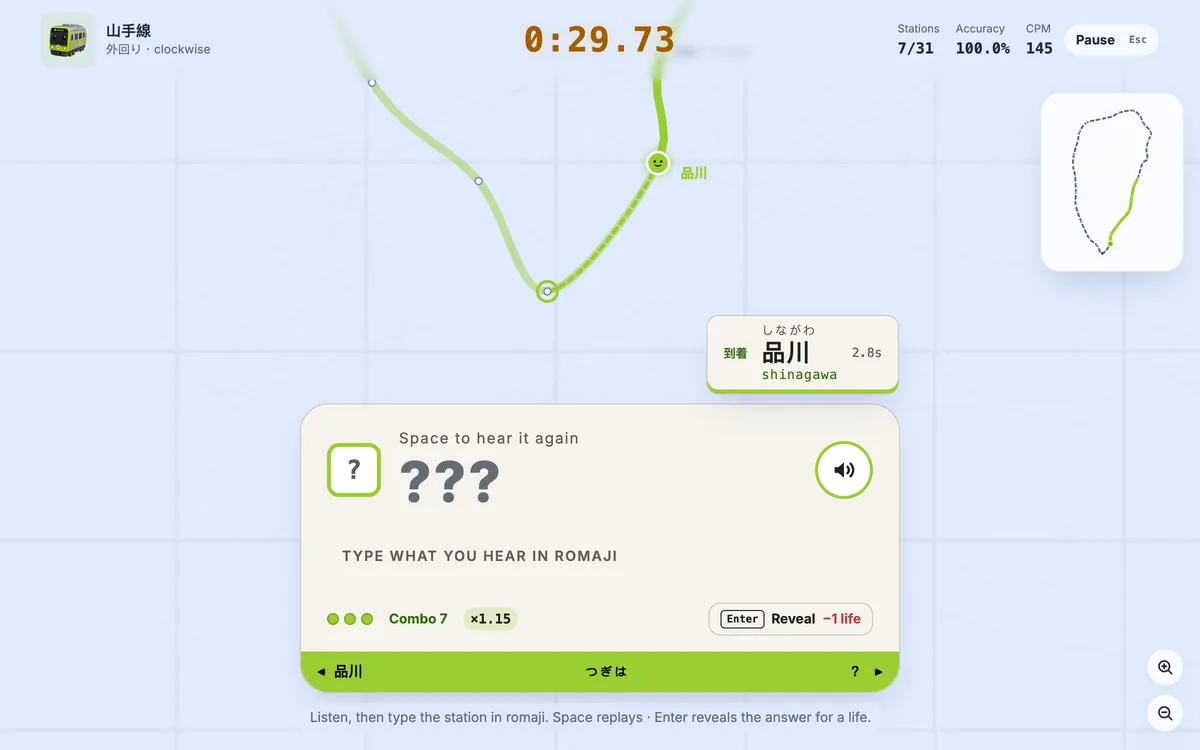
Tokyo Rail Typing is more than a Yamanote Line typing test. The game now turns 125 real railway lines across Tokyo, Osaka, Kyoto, Sapporo, Hakodate, Nagoya and Fukuoka into playable typing routes — the Japanese part of a 128-line network that also reaches the London Underground. Every correct letter moves the train toward the next station, so learning a network feels less like memorizing a list and more like completing a journey.
Which railway lines can you type?
The collection spans 38 Japanese operator groups, adding Nagoya Municipal Subway and Fukuoka City Subway to the established subway, JR and private-railway networks. It includes familiar urban lines and longer intercity challenges:
- Hokkaido additions: the Sapporo Streetcar loop, Chitose main line, Gakuen-Toshi Line, Otaru–Iwamizawa section of the Hakodate Line, and Hakodate City Tram Route 2
- Nagoya’s Higashiyama Line and the full Meijo loop
- Fukuoka City Subway's Kuko, Hakozaki and Nanakuma lines
- Tokyo classics such as the Yamanote, Ginza, Marunouchi and Oedo lines
- JR East routes including Chuo, Keihin-Tohoku, Saikyo and Tokaido
- Osaka staples such as the Midosuji and Osaka Loop lines
- Through services onto the Osaka subway: Kita-Osaka Kyuko onto Midosuji, Hankyu’s Kyoto Line onto Sakaisuji via the Senri Line, and Kintetsu’s Keihanna Line onto Chuo
- Kyoto’s two subway lines, the Karasuma and Tozai lines, plus the Keihan Main Line down to Osaka
- Private railways such as Tokyu’s Den-en-toshi Line
- Tokyo Bay and Yokohama: the Yurikamome, Yokohama’s Blue Line, the Minatomirai Line and Sotetsu, plus the Keikyu Airport Line to Haneda and the Narita Sky Access Line
- Suburban links and branches: the Keisei Oshiage, Hokuso, Toyo Rapid and Saitama Railway lines that carry subway trains out of Tokyo, the Tokyu and Sotetsu Shin-yokohama lines, Keio’s Sagamihara and Odakyu’s Tama lines into Tama New Town, the Tokyu Tamagawa Line, Yokohama’s Green Line and Tobu’s Urban Park Line
- The whole Sapporo Municipal Subway, on rubber tyres
- Airport and high-speed routes, including the Kansai Airport Line and Tokaido–Sanyo Shinkansen
This variety makes the game useful at every level. A seven-station Itsukaichi run is a quick warm-up; a 47-station Keihin-Tohoku run tests endurance and concentration.
Real station order makes practice memorable
Each route follows its real station order. Linear lines run from terminal to terminal, while loop lines return to the starting station. Instead of typing unrelated words, you repeatedly meet place names in a meaningful sequence. That context helps station names stick.
The visual identity of each route matters too. Line codes, operator names, colors and station counts make it easy to recognize what you are about to play. If you are learning Japanese transport for a future trip, the practice doubles as network orientation.
One game, three kinds of progress
Every line supports Romaji, Kana and Kanji input. Your best result is stored separately for each line and mode, so experimenting never erases another record. After a run, time, CPM, WPM, accuracy and station splits show exactly where you improved.
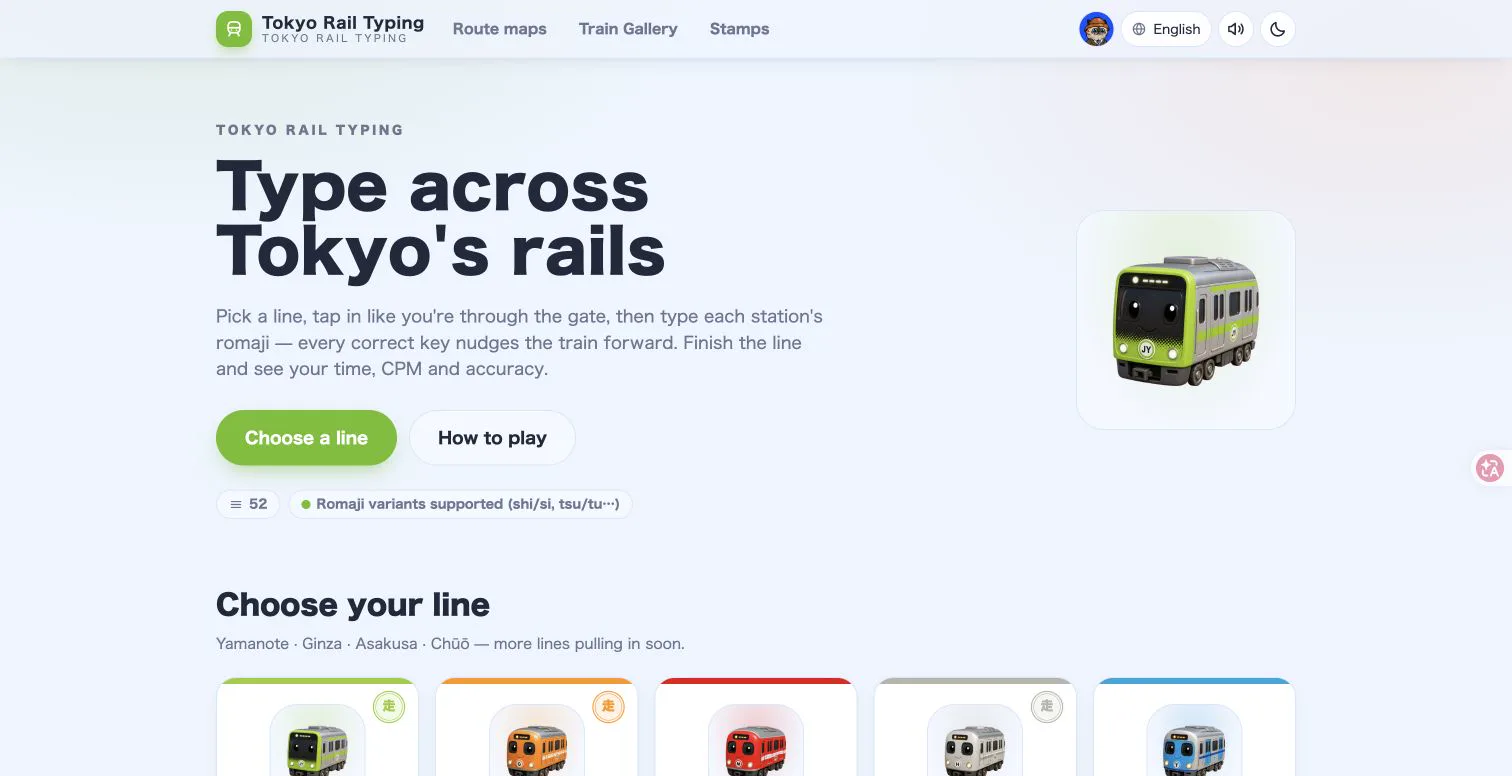
Start with the Yamanote Line, browse the complete route map collection, or learn how to choose between Romaji, Kana and Kanji. Pick one line today; Japan's railway network will provide the next 124 challenges.