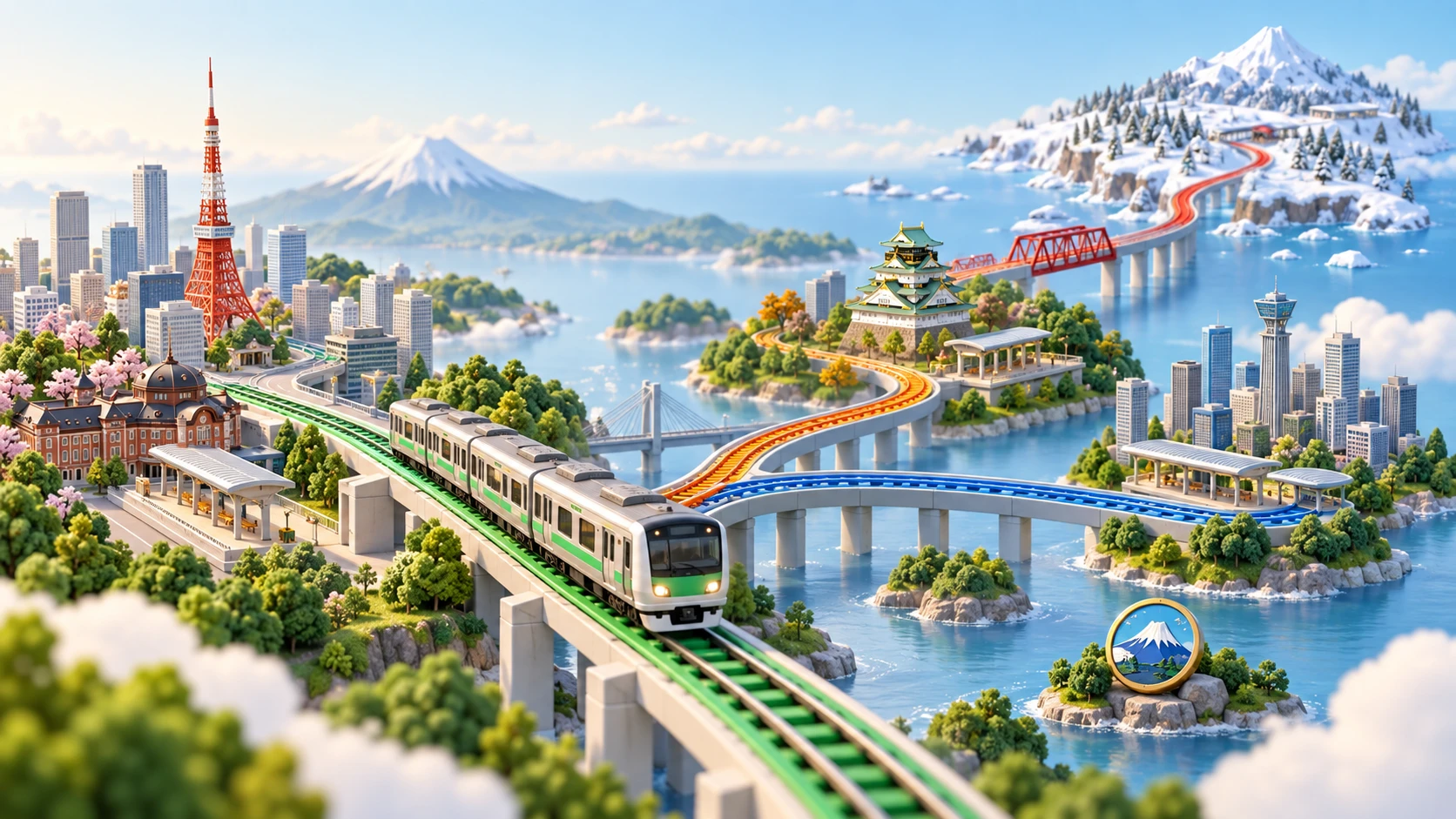
If the Yamanote is a green loop wrapped around central Tokyo, the JR Chuo Line (Rapid) is the bright orange arrow that shoots straight through it. It runs east to west from Tokyo Station out to the western suburbs, cutting a clean chord across the loop on its way. This guide covers what the line is, the stations worth knowing, and why it makes such a satisfying line to type in Tokyo Rail Typing.
What the Chuo Line is
The JR Chuo Line (Rapid) is operated by JR East and wears an unmistakable orange livery — so much so that "the orange line" is how many riders think of it. Where the Yamanote curls around in a loop, the Chuo does the opposite: it is a straight east-west trunk line, starting at Tokyo Station and running out through Shinjuku toward Mitaka, Tachikawa, and the mountains beyond.
That shape is the whole appeal. Instead of circling the same hubs, the Chuo Rapid blows past the local stops and connects the eastern core to the western suburbs in one confident run.
A chord across the loop
The most useful way to picture the Chuo is against the Yamanote. The Yamanote loop links Tokyo and Shinjuku the long way around — up through Ueno or down through Shibuya. The Chuo simply cuts straight across the middle between those two hubs, a chord slicing through the circle.
That is why the orange line feels so fast. It trades the scenic loop for the shortcut, and on a busy day the difference of skipping half a lap is enormous.
Stations worth knowing
In Tokyo Rail Typing the Chuo is a linear line, so every run is a full terminal-to-terminal traversal — no partial laps. Here are the stops that define the ride, west from the eastern anchor:
- Tokyo — the eastern terminal and shinkansen gateway.
- Kanda — the first hop, short and snappy.
- Ochanomizu — perched above the river, student and book-town country.
- Yotsuya — where the line dips past the palace moat.
- Shinjuku — the world's busiest station and the line's beating heart.
- Nakano — subculture and the famous Broadway arcade.
- Koenji — a laid-back neighborhood of vintage shops and live houses.
- Kichijoji — perennially voted Tokyo's most livable town, next to Inokashira Park.
- Mitaka — the western anchor, home of the Ghibli Museum.
Why it's satisfying to type
The Chuo has a rhythm all its own. Short, punchy names like Kanda and Nakano sit between longer four-mora climbs like Ochanomizu and Kichijoji, so your fingers are constantly shifting gears. Because it is linear, a run is a clean sprint from one end to the other — pick your direction, and you always cover the same ground, which makes chasing a personal best straightforward.
Type each station to move the train, and at the finish you get your total time, CPM, WPM, accuracy, and per-station splits. Play in romaji to start, kana once the sounds feel automatic, or kanji (IME) for the highest ceiling — your best is tracked separately for each line and mode.
Ride the orange line
The Chuo is the perfect change of pace after the loop: same city, completely different shape. Play the Chuo Line and feel Tokyo rush past from east to west.
For contrast, take a lap on the Yamanote Line or read the Yamanote Line guide. To understand how JR fits alongside the subway, see Tokyo Metro vs JR, or browse all articles.