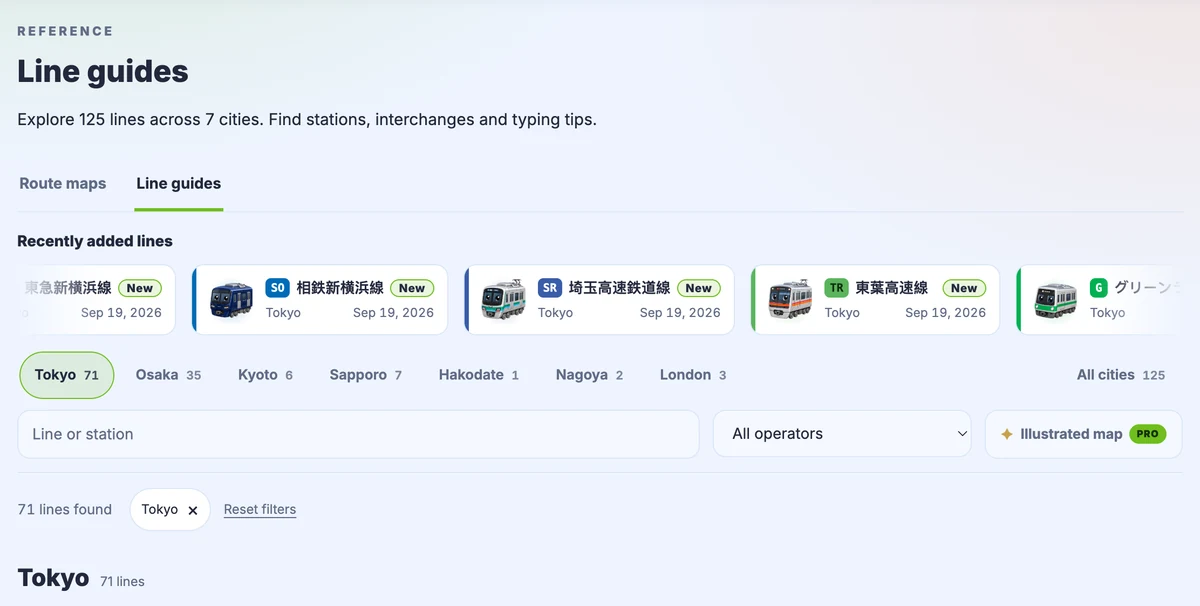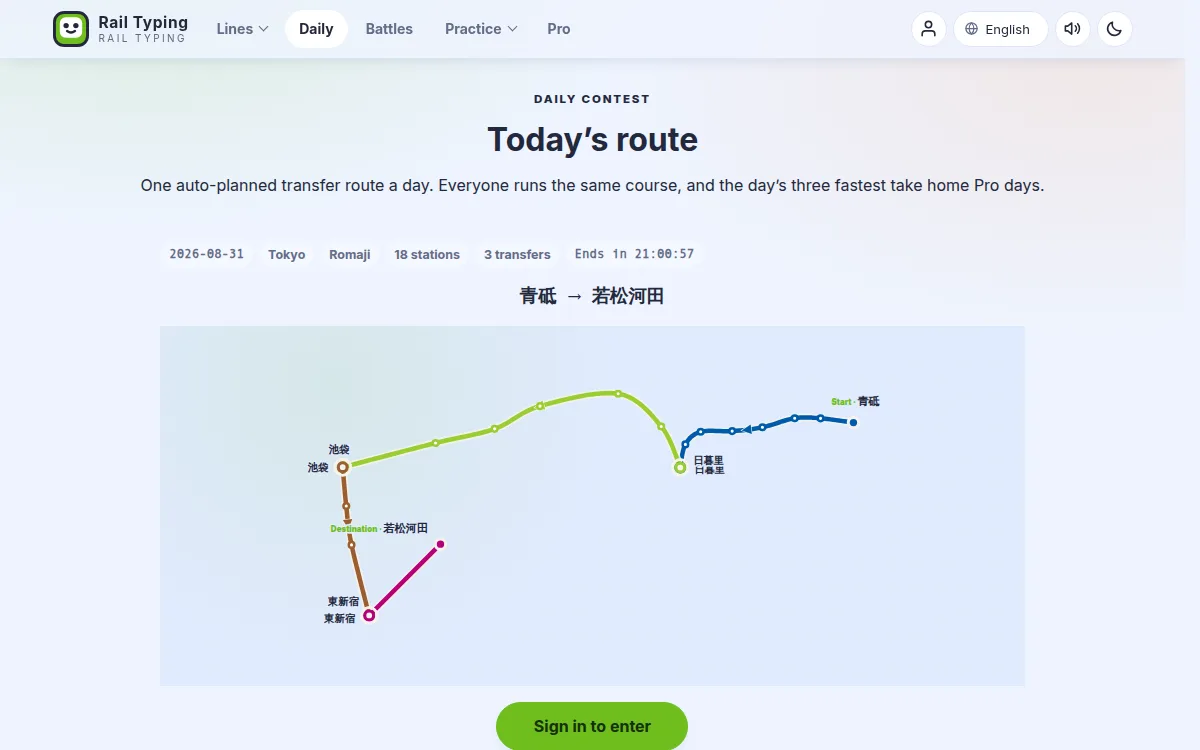
Ride the rails in Tokyo and you quickly notice the network is not run by one company. Three big operators share the city — Tokyo Metro, Toei Subway, and JR East — each with its own lines, colors, and letter codes. Knowing who runs what makes transfers less confusing, and it makes the lines a lot more fun to type in Tokyo Rail Typing.
Why Tokyo has three operators
Most world cities have a single subway authority. Tokyo grew differently: two separate subway networks were built underground, and a national railway laid the surface network on top. The result is a city where "the subway" and "the trains" are run by different organizations that nonetheless connect seamlessly. Every line carries a letter code and a color so you can navigate by sign and map even without reading Japanese.
Tokyo Metro — the private subway giant
Tokyo Metro runs nine lines and is the busier of the two subway operators. Its lines are the ones most travelers picture when they think "Tokyo subway":
- Ginza Line (G) — orange; the oldest subway line in Asia, running through Asakusa, Ueno, and Ginza.
- Marunouchi Line (M) — red; a winding line through Tokyo Station and Shinjuku.
- Hibiya Line (H) — silver; connects Ueno, Ginza, and Roppongi.
- Tozai Line (T) — sky blue; the fast east–west artery.
- Chiyoda Line (C) — green; plus Yurakucho, Hanzomon, Namboku, and the newer Fukutoshin line.
Each station has a code like G09 (line letter + number), so "Ginza on the Ginza Line" becomes an unmistakable label. The Ginza Line is a great first taste — try a run on /play/ginza or read the Ginza Line guide.
Toei Subway — run by the city itself
Toei is the Tokyo metropolitan government's subway, with four lines. It shares stations and transfers with Tokyo Metro, but tickets are priced separately, so locals learn to tell them apart:
- Asakusa Line (A) — rose; the first Toei line, linking both airports via through-service.
- Mita Line (I) — blue; a north–south route.
- Shinjuku Line (S) — leaf green; runs west out of the center.
- Oedo Line (E) — magenta; a deep, looping line that reaches corners the others miss.
If a line's code starts with A, I, S, or E, it is Toei, not Tokyo Metro. That single habit clears up most of the confusion travelers feel about the "Toei subway" versus the private network.
JR East — the surface backbone
JR East is not a subway operator at all — its trains run mostly above ground — but it is the backbone of Tokyo rail. Its lines carry enormous commuter volumes and define how the city is laid out:
- Yamanote Line — the famous green loop of 30 stations ringing central Tokyo.
- Chuo Line — orange; the fast east–west line slicing across the loop.
- Keihin-Tohoku, Saikyo, and Sobu — high-frequency commuter lines fanning out to the suburbs.
The Yamanote loop is the single most useful line to know in Tokyo, and the classic first line to type — start with the Yamanote Line guide or jump straight into /play/yamanote.
How to tell them apart
- Letter codes: G/M/H/T/C and the rest are Tokyo Metro; A/I/S/E are Toei; JR lines use names and route colors rather than metro-style letters.
- Logos: Tokyo Metro's heart-shaped "M", Toei's ginkgo-leaf mark, and JR's boxy "JR" logo appear on every sign.
- Underground vs. surface: if you are deep below ground, you are almost certainly on Metro or Toei; JR mostly runs at street level or on elevated tracks.
Try them in the game
Tokyo Rail Typing includes lines from all three operators — plus a few from JR West, Osaka Metro and the Kyoto Municipal Subway for when you want to venture beyond Tokyo. Pick any line, choose a start station and direction, and type the station names to run a train straight through it. Every run reports your time, CPM, WPM, accuracy, and per-station splits.
Start with the private subway on /play/ginza or the JR backbone on /play/yamanote, read the Ginza line intro, and browse more guides on the blog when you are ready for the next operator.