For as long as this game has existed there was one station you never typed: the one you started from. You picked it, the train sat on it, and the first name that actually cost you a keystroke was the one after it.
On a loop line that was easy to miss. On a straight line it was worse — you never even chose a start, because the origin terminal follows from the direction you pick. So nobody had ever typed 大船 on the Keihin-Tōhoku Line, or 浅草 on the Ginza Line. Those stations existed in the game and were unreachable by the only verb the game has.
That has changed. The station you start at is now the first name you type.
What a run looks like now
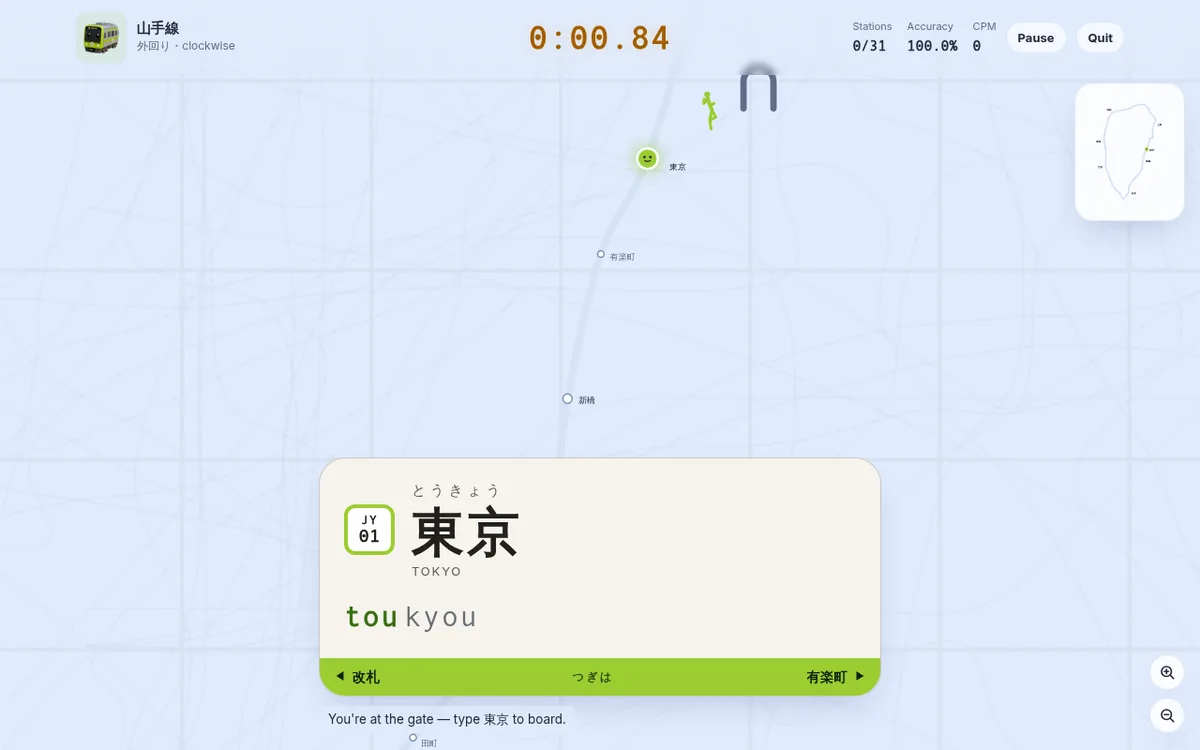
A Yamanote Line lap used to be 30 station names. It is now 31: every station once, plus the station you started from, again, at the end. The counter in the corner says 0/31 before you have typed anything.
Straight lines gained a name too. A Keihin-Tōhoku run is all 47 of its stations now, 大船 included, rather than the 46 that came after it.
Everything else about a run is the same. Accuracy, CPM and WPM are calculated exactly as before; there is simply one more name in front of them.
You start outside the gate
If the first thing you type is the station you are standing in, then at the moment the countdown ends you are not on the platform yet — you are outside, at the ticket gate. The board says so. The strip along the bottom that normally reads the station behind you has no station to name, so it reads 改札 instead, or Ticket hall on the London lines.
And because you have not boarded, the train has nothing to do. It sits on the start station for the whole of this first leg. Rather than leave the map frozen for the opening name of every run, that leg got its own thing to watch:
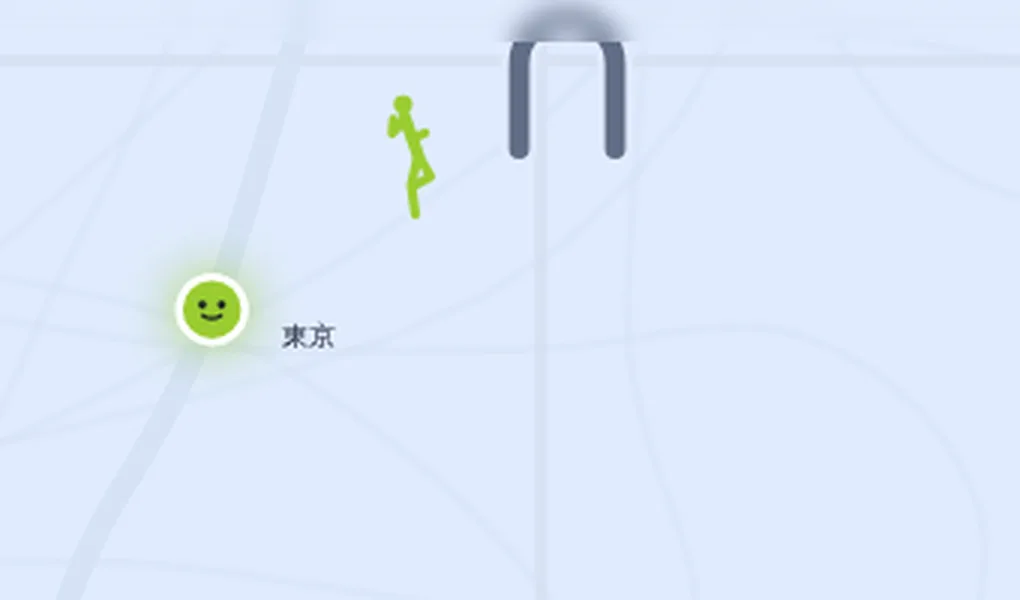
A figure runs out of a street entrance and onto the platform while you type. It is drawn in the flat black-silhouette style of Japanese station signage — the same visual language as the 非常口 running man — and it is original artwork, drawn in code like the London roundel rather than lifted from anywhere.
The part worth knowing: its stride is your typing speed. The pose changes are driven by how far it has travelled, not by a clock. Type quickly and it sprints. Stop to think and it stops too, frozen mid-step, one foot off the ground, until you hit the next key. When you finish the name, it disappears into the station and the train takes over for the rest of the run.
Loop lines type their start station twice
Once on the way in, once when the loop brings you back to it. That is why the Yamanote lap is 31 names for 30 stations.
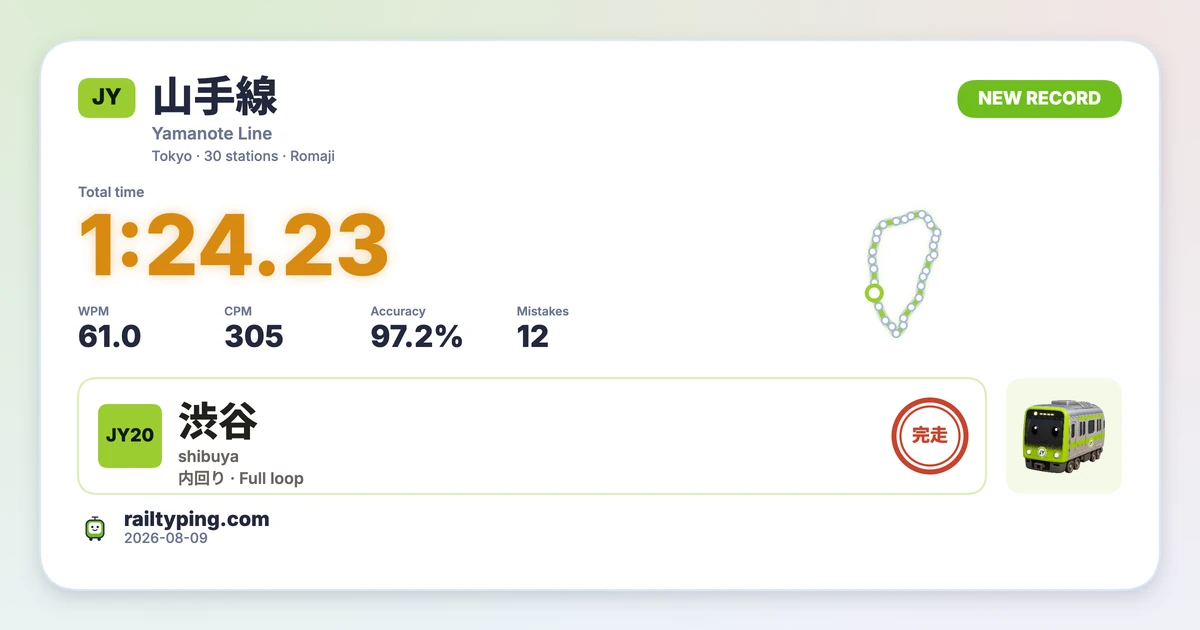
It sounds like an oddity and it is actually the point. A loop run has always ended where it began — that is what makes a lap the same length no matter which of the 30 stations you choose to start at, and therefore what makes two players' times comparable. Adding the boarding leg keeps that property intact: 渋谷 at the start and 渋谷 at the end, with the whole ring in between.
Why every leaderboard started over
One extra station name per run means times set before this change and times set after are not measuring the same thing. A 31-name lap is simply more typing than a 30-name lap.
So every line's version number moved, and every leaderboard opened fresh. Personal bests are tracked against the new version too — your next run on any line will set one.
No old score was deleted. They are all still in the database under their old board, and while a new board is still thin you will find the previous version's rankings underneath it, collapsed, clearly labelled as the old rules. They are kept separate on purpose: those runs were one station shorter and therefore strictly faster, and merging them would park them at the top of the table for good. Once the new board fills up, the archive quietly retires itself.
A bug this turned up
The weakness drill builds a custom practice line out of the stations whose kana you keep missing. Because the game never used to type the station you departed from, the drill had to insert a filler station at the front so your actual weakest station would not be skipped — 東京, chosen precisely because it was not one of your problem stations.
That workaround is now the opposite of what you want, and it is gone. A drill starts on your weakest station, immediately.
The best way to see any of this is to run it. Start a Yamanote lap and watch the first name on the board: it is the station you are standing in, and there is someone at the gate waiting for you to type it.