Everyone wants to type faster, but raw speed on its own is fragile — it falls apart the moment a hard station name shows up. The good news is that Tokyo Rail Typing gives you real feedback (CPM, WPM, accuracy, and per-station splits) that turns "type faster" from a vague wish into a training plan. Here is how to raise your typing WPM the way runners raise their pace: with warm-ups, drills, and honest numbers.
Warm up before you race
Cold hands lose runs. Spend two or three minutes getting your fingers moving before you chase a personal best:
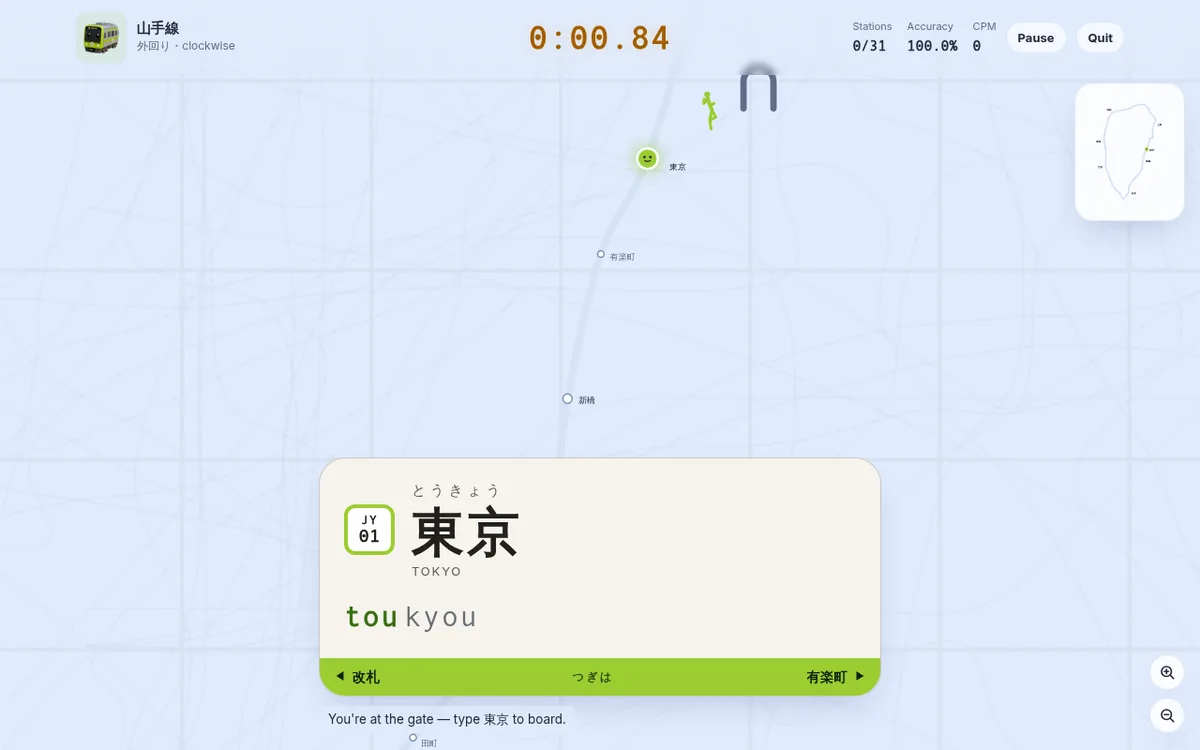
- Do one easy lap on the Yamanote Line in Romaji mode without watching the clock — just find a smooth rhythm.
- Type a couple of short lines like the Ginza Line to wake up the less-used keys.
- Reset your posture: wrists floating, eyes on the station board, not on the keyboard.
Warming up first is the single easiest way to improve typing speed, because your first "real" run starts from full pace instead of building up mid-lap.
Accuracy first, speed second
It feels backwards, but the fastest players are the most accurate ones. In this game a wrong key is simply rejected — the train does not move, and you never need backspace. That means every mistyped key is pure wasted time with no way to "catch up."
So chase clean keystrokes, not frantic ones. Slow down by five percent until your accuracy sits near 100%, then let speed come back on its own. A steady 350 CPM at 99% accuracy beats a jittery 420 CPM that stalls on every third station.
Read your splits like a coach
The results screen is where the real training happens. After each run, look past the headline WPM and study the per-station split times:
- Find your three slowest stations. Long hub names like Shinjuku and Shibuya are common culprits.
- Drill just those names — start a run near them and repeat the tricky stretch a few times.
- Compare splits across runs to see whether a fix actually stuck.
Splits turn one bad lap into a specific to-do list. That is how you improve typing speed on purpose instead of by accident.
Use input modes as difficulty gears
Your input mode is a speed dial, and your personal best is tracked per line, per mode, so you can push each one independently:
- Romaji is the friendliest and usually your highest raw WPM — great for pure speed drills.
- Kana fills the board in kana as you type romaji, with no IME to fight, so it trains your reading without much extra cost.
- Kanji (IME) is the most authentic Japanese typing practice and has the highest long-term ceiling, even if it feels slower at first.
A smart plan is to set fast records in Romaji, then rebuild them in Kana and Kanji. See Romaji vs Kana vs Kanji for a deeper comparison.
Build a simple weekly routine
You do not need hours. Fifteen focused minutes beats an hour of mashing:
- Warm up on one easy lap.
- Run the Chuo Line or a short line for a fast, low-pressure set.
- Do one all-out lap on the Yamanote Line and record the result.
- Drill your two slowest splits, then try to beat that lap.
Repeat a few times a week and your CPM curve will climb on its own. When you are ready to hunt a specific record, read Perfect Yamanote lap, and if you are brand new, start with Getting started. More guides live on the blog.