A player wrote in with a request, and the reason they gave was one sentence long:
If possible, I would love to see the Den-en-toshi Line added. The reason is simple — I just think the station names are beautiful.
That is a better argument than it looks. Most Japanese lines in this game are typed as kanji names with kanji readings: 大手町, 品川, 天王寺. The Tokyu Den-en-toshi Line is full of stations that are written in kana — たまプラーザ, すずかけ台, つくし野, つきみ野, あざみ野 — and typing them feels different in a way you notice within about four stops.
So it is in. 27 stations, Shibuya to Chuo-rinkan, and with it the game's first 大手私鉄 — major private railway — outside Tokyo Metro. Everything else here until now has been JR, the municipal subways and the London Underground; Tokyo Metro is the odd one out, a subway that has counted as one of Japan's sixteen 大手私鉄 ever since it was privatised in 2004.
The route: Shibuya to Chuo-rinkan
The Den-en-toshi Line runs 31.5 km southwest out of Shibuya, and the average gap between its stations is only 1.2 km — dense even by Tokyo standards.
The first stretch is underground, running beneath Setagaya through Ikejiri-ohashi, Sangen-jaya, Komazawa-daigaku, Sakura-shimmachi and Yoga. It surfaces at Futako-tamagawa to cross the Tama River, and from there to Mizonokuchi it runs on four tracks it shares with Ōimachi Line services.
Then it starts climbing. Kajigaya, Miyazakidai, Miyamaedaira and Saginuma go up into the hills of Kawasaki, and after that come the suburbs Tokyu built for itself: Tama-plaza, Azamino, Eda, Ichigao, Fujigaoka, Aobadai. This is the 多摩田園都市 — the "Tama garden city" the line is named after, a development the railway company planned, sold and then ran the trains to.
Tana and Nagatsuta bring the interchange with the JR Yokohama Line. Tsukushino, Suzukakedai and Minami-machida Grandberry Park cross briefly back into Tokyo at Machida, and then the line hops the Sakai River into Kanagawa to finish at Tsukimino and Chuo-rinkan, where the Odakyu network takes over.
One thing worth knowing before you play it: Shibuya is not a terminus. It is a through-station. Real Den-en-toshi trains keep going onto the Tokyo Metro Hanzomon Line and, past Oshiage, onto Tobu's Skytree and Nikko lines — a single train can start in Kanagawa and end up in Saitama. In the game the run stops at Shibuya, but the Hanzomon Line is right there if you want the rest of it.
Why these station names type differently
Here is the thing the player who requested it was pointing at.
The kana names. たまプラーザ, あざみ野, つくし野, すずかけ台, つきみ野 — five stations out of 27 whose names are not kanji compounds. After a few dozen laps of lines like the Yamanote, where every stop is two or three kanji, these land on the fingers as a completely different rhythm. They are also softer: あざみ (thistle), つくし (horsetail shoots), つきみ (moon-viewing), すずかけ (plane tree). This is a railway that named its stations after plants and moonlight, because it was selling the neighbourhoods at the same time.
The が run. Fujigaoka, Ichigao and Kajigaya put three が in a row within a few stops. Say them out loud and you can hear why the line feels rhythmic to type.
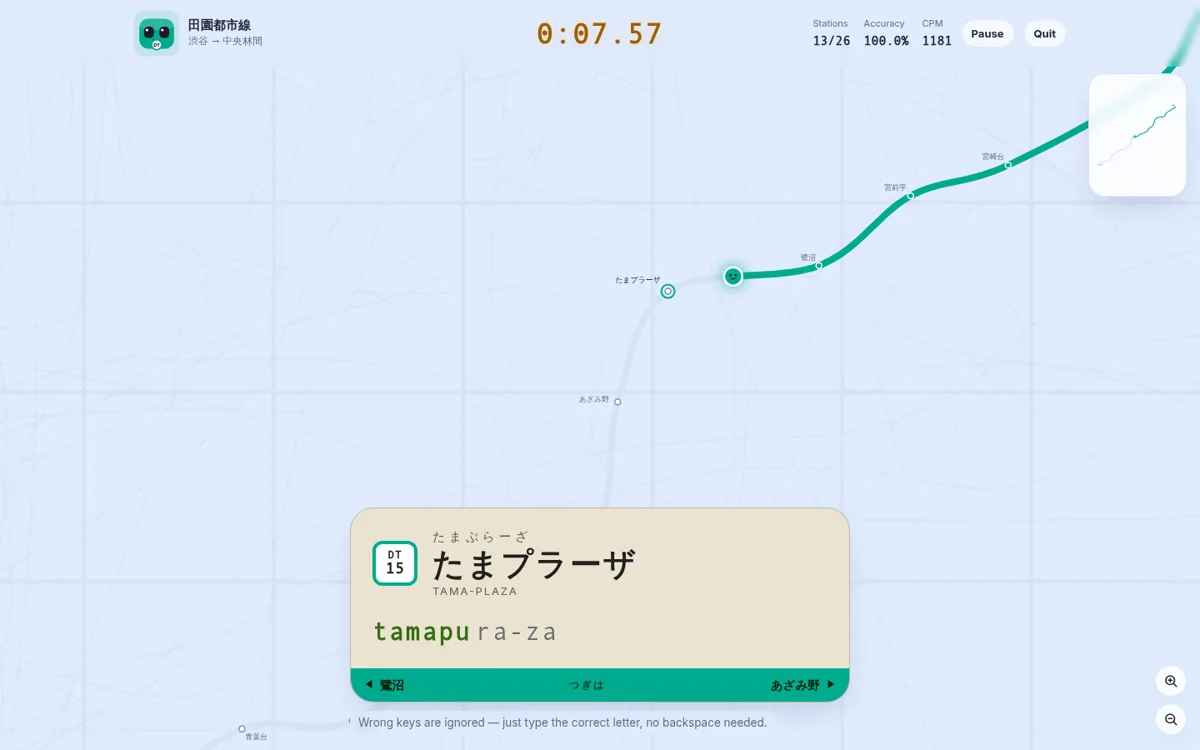
The long-vowel mark. たまプラーザ is typed tamapura-za — the ー is a literal hyphen key, the way a Japanese IME takes it. If you have only played kanji-name lines, this is probably the first time you have had to reach for it mid-station.
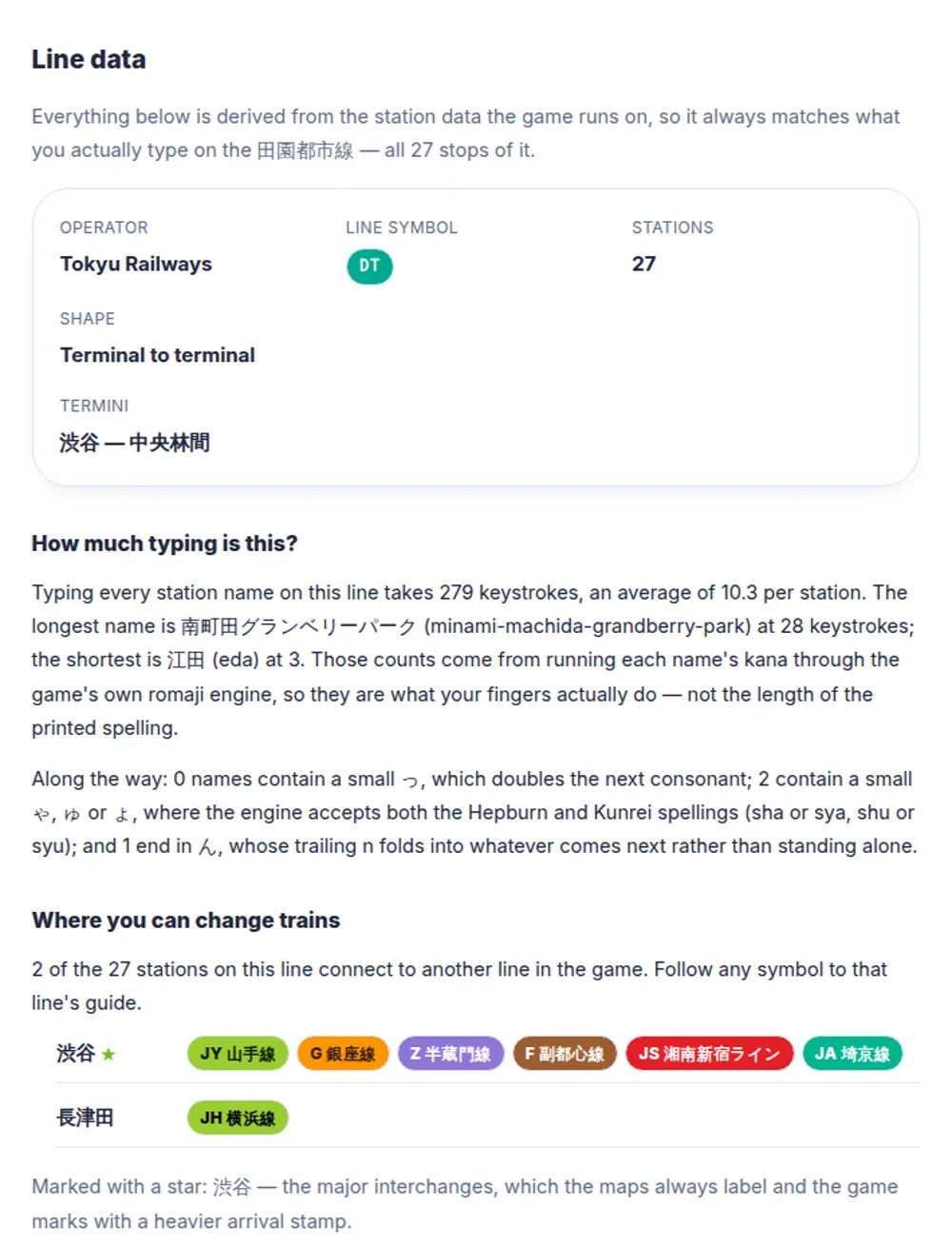
The boss at DT25. 南町田グランベリーパーク is the longest station name in the entire game — twelve characters, minamimachidaguranberi-pa-ku, 28 keystrokes. It was plain 南町田 until October 2019, when the shopping complex opened and the station was renamed with it. On the route map it shows as 南町田GBP, because the full name would sit on top of its neighbours.
The station that changed the typing engine
Station DT03 is 三軒茶屋, and its official reading is さんげんぢゃや — with ぢ, not じ.
That is not a typo on Tokyu's part. The place name comes from 三軒の茶屋, "three teahouses", and ちゃや voices into ぢゃや. Tokyu still prints it that way, and has even posted about it themselves, warning that if you type it the obvious way your IME will give you the wrong kanji: type DYAYA, they said.
This mattered here because 三軒茶屋 is the only ぢゃ anywhere in the game's whole collection of lines, and the romaji engine accepted exactly one spelling for it: dya. Correct, IME-faithful, and completely at odds with what a player's fingers would do — Tokyu itself romanizes the station "Sangen-jaya", so sangenjaya is what anyone reading the sign would type.
Rather than falsify the reading, the engine changed. ぢゃ / ぢゅ / ぢょ now accept the じゃ spellings too, so sangenjaya, sangenjyaya, sangenzyaya and sangendyaya all work. The canonical spelling is still dya, so the romaji reference table shows the IME-correct form first and lists the rest as alternates. Nobody is punished for either habit, and the data still says what Tokyu says.
The first private railway outside Tokyo Metro
Until now the operators here have been JR East, JR West, Tokyo Metro, Toei, the Osaka and Kyoto municipal subways, and London Underground. Tokyo Metro has counted as one of Japan's sixteen 大手私鉄 since it was privatised in 2004, but Tokyu is the first of the others to arrive — the big private railways, the companies that, in the Tokyo of the twentieth century, built the train line and the suburb and the department store at the terminus as one business. The Den-en-toshi Line is close to the purest example of that model still running.
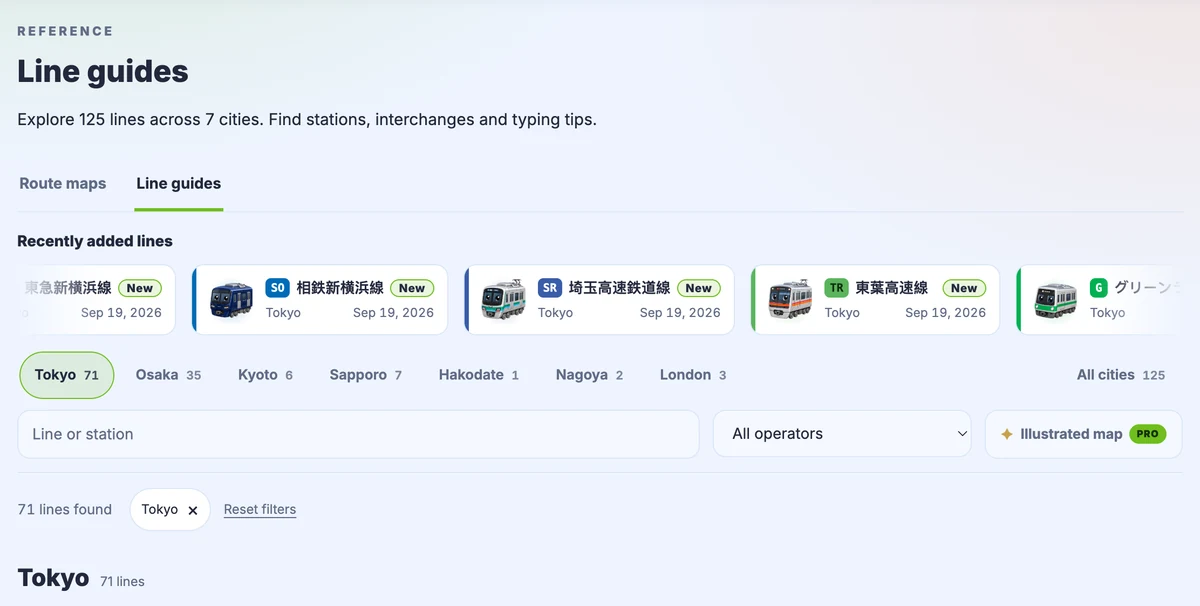
Practically, that means a new Tokyu Railways group on the route map collection and in the line guides, and a new sweep badge on your stamp sheet — which right now takes exactly one run to earn, since the group has exactly one line in it. That is deliberate. This is a pilot: if the line lands well, Toyoko, Ōimachi and Meguro are the obvious next ones, and after Tokyu there is Odakyu, Keio, Seibu, Tobu and Keikyu.
Where it connects
Two of the 27 stations link to lines already in the game:
- Shibuya (DT01) — the Yamanote, Ginza, Hanzomon, Fukutoshin, Shonan-Shinjuku and Saikyo lines.
- Nagatsuta (DT22) — the JR Yokohama Line.
Both work in the route planner, so you can now plan a journey that starts on a JR line and finishes deep in the Kanagawa hills.
Update, 17 September 2026: the one gap this post admitted to at launch is closed. Mizonokuchi (DT10) is a real-life interchange with the JR Nambu Line, even though the Nambu station is called 武蔵溝ノ口 — different name, different kana, even a different の. The route planner now treats the two as one interchange, so a suggested route can change trains there instead of going the long way round.
Try it
A full run is all 27 stops — 26 names to type from Shibuya, or the same trip in reverse from Chuo-rinkan.
- Play the Den-en-toshi Line
- Read the line guide — every station with its kana and romaji
- See it on the route map
And if there is a line you want that is not here yet, say so. This one exists because somebody sent a short, polite message about station names being pretty.