Overview
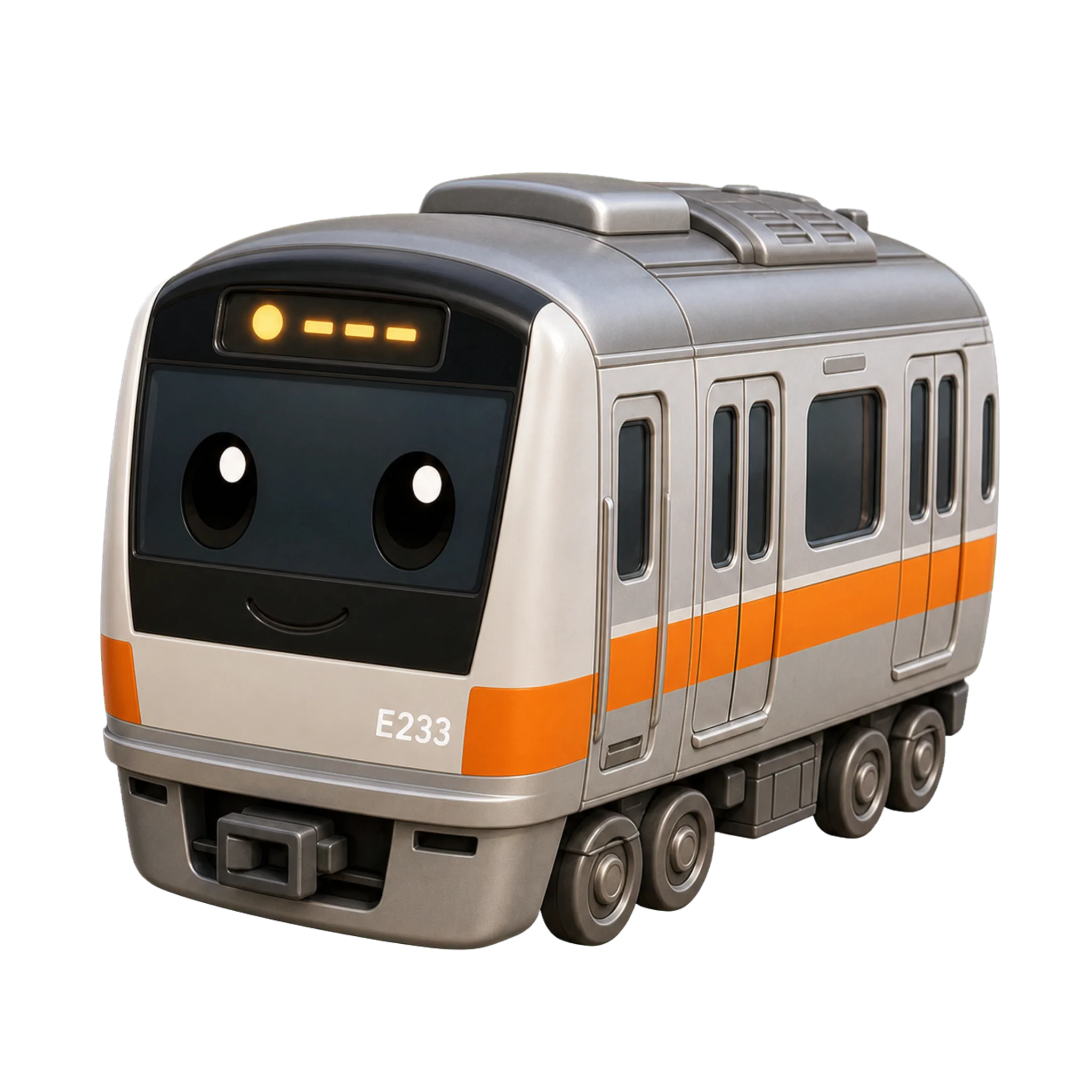
The Chuo Line (Rapid) (JC) is JR East's main west-bound commuter artery, running dead straight from Tokyo Station out to Takao across 24 stations. Its orange-banded E233 series is practically shorthand for the line itself — on the elevated platforms at Tokyo Station, that stripe of orange is the first thing you spot.
The straightness is real, not a figure of speech: the stretch between Shinjuku and Tachikawa is one of the longest sections of dead-straight railway in Japan, about 25 km without a meaningful curve. The usual explanation is that the Meiji-era surveyors simply drew a line across the Musashino plain because nothing stood in the way, and nothing has stood in the way since.
Along the route
Past Kanda the line briefly vaults the Kanda River gorge at Ochanomizu, calls at the giant interchanges of Yotsuya and Shinjuku, then threads the lived-in neighbourhoods of Nakano, Koenji and Ogikubo before reaching bookish, boutique-filled Kichijoji. West of Mitaka it heads into the Tama plain — Kokubunji, Tachikawa, Hachioji — and finishes at Takao, the gateway station for Mount Takao.
The Nakano-to-Kichijoji stretch has its own culture: secondhand bookshops, tiny live music venues, Koenji's summer Awa-odori festival, and enough cheap izakaya to have given the phrase "Chuo Line type" a meaning in Japanese that has nothing to do with trains. Kichijoji has topped Tokyo's "most desirable place to live" surveys for most of the last two decades.
Where the typing gets hard
Twenty-four stations, 211 keystrokes, an average of 8.8 per stop — and, like the Tozai Line, no sokuon anywhere. Nothing doubles, nothing stutters, which makes this one of the smoothest lines in the game.
The difficulty is entirely in the Tama half, and it comes in near-identical pairs. Higashi-koganei (higashikoganei, 14) is immediately followed by Musashi-koganei (musashikoganei, 14) — fourteen keystrokes each, differing only in the prefix. Two stops later Kokubunji (kokubunji) is followed by Nishi-kokubunji (nishikokubunji, 14). Then Hachioji is followed by Nishi-hachioji (nishihachiouji, 14).
Three prefix pairs in the final ten stations. The names are not individually hard; the problem is that your fingers finish the previous station's name from memory and you lose the nishi.
The first half is fast. Tokyo, Kanda, Nakano, Ogikubo, Mitaka, Hino (4 keystrokes) — short, familiar, and only four stations on the whole line contain a small ゃ/ゅ/ょ.
How to practise it
Run it Tokyo toward Takao. The short central names come first and the prefix pairs cluster at the end, so it works as a proper warm-up-then-test structure.
The specific drill worth doing: type higashikoganei musashikoganei kokubunji nishikokubunji hachiouji nishihachiouji a few times outside the game. Once those six stop feeling like three names typed twice, your Chuo time will drop noticeably — for most players this is worth more than raw speed practice.
With no doubled consonants and a light 8.8 average, this line rewards clean, continuous typing more than almost any other in the game.
Why play it
Straight, fast, and light on stops. Station names ramp up from short ones like "Tokyo" to mouthfuls such as Musashi-koganei and Nishi-kokubunji, making it an ideal line for building stamina on long kana strings.
Line data
Everything below is derived from the station data the game runs on, so it always matches what you actually type on the 中央線 — all 24 stops of it.
- Operator
- JR East
- Line symbol
- JC
- Stations
- 24
- Shape
- Terminal to terminal
- Termini
- 東京 — 高尾
How much typing is this?
Typing every station name on this line takes 211 keystrokes, an average of 8.8 per station. The longest name is 東小金井 (higashi-koganei) at 14 keystrokes; the shortest is 日野 (hino) at 4. Those counts come from running each name's kana through the game's own romaji engine, so they are what your fingers actually do — not the length of the printed spelling.
Along the way: 0 names contain a small っ, which doubles the next consonant; 4 contain a small ゃ, ゅ or ょ, where the engine accepts both the Hepburn and Kunrei spellings (sha or sya, shu or syu); and 0 end in ん, whose trailing n folds into whatever comes next rather than standing alone.
Where you can change trains
15 of the 24 stations on this line connect to another line in the game. Follow any symbol to that line's guide.
- 東京JY 山手線M 丸ノ内線JK 京浜東北線JO 総武快速・横須賀線JT 東海道線JU 宇都宮線JE 京葉線
- 神田JY 山手線G 銀座線JK 京浜東北線
- 御茶ノ水M 丸ノ内線JB 中央・総武線各駅停車
- 四ツ谷M 丸ノ内線N 南北線JB 中央・総武線各駅停車
- 新宿JY 山手線M 丸ノ内線S 新宿線E 大江戸線JB 中央・総武線各駅停車JS 湘南新宿ラインJA 埼京線KO 京王線OH 小田原線SS 新宿線
- 中野T 東西線JB 中央・総武線各駅停車
- 高円寺JB 中央・総武線各駅停車
- 阿佐ケ谷JB 中央・総武線各駅停車
- 荻窪M 丸ノ内線JB 中央・総武線各駅停車
- 西荻窪JB 中央・総武線各駅停車
- 吉祥寺JB 中央・総武線各駅停車IN 井の頭線
- 三鷹JB 中央・総武線各駅停車
- 西国分寺JM 武蔵野線
- 立川JN 南武線JC 青梅線
- 八王子JH 横浜線
Marked with a star: 東京・新宿・中野・立川 — the major interchanges, which the maps always label and the game marks with a heavier arrival stamp.
Every station on the line
All 24 stations in order, with the official station number, the name in kanji, the kana the typing is derived from, and its Hepburn romaji.
| # | No. | Station | Kana | Romaji |
|---|---|---|---|---|
| 1 | JC01 | 東京 | とうきょう | tokyo |
| 2 | JC02 | 神田 | かんだ | kanda |
| 3 | JC03 | 御茶ノ水 | おちゃのみず | ochanomizu |
| 4 | JC04 | 四ツ谷 | よつや | yotsuya |
| 5 | JC05 | 新宿 | しんじゅく | shinjuku |
| 6 | JC06 | 中野 | なかの | nakano |
| 7 | JC07 | 高円寺 | こうえんじ | koenji |
| 8 | JC08 | 阿佐ケ谷 | あさがや | asagaya |
| 9 | JC09 | 荻窪 | おぎくぼ | ogikubo |
| 10 | JC10 | 西荻窪 | にしおぎくぼ | nishi-ogikubo |
| 11 | JC11 | 吉祥寺 | きちじょうじ | kichijoji |
| 12 | JC12 | 三鷹 | みたか | mitaka |
| 13 | JC13 | 武蔵境 | むさしさかい | musashi-sakai |
| 14 | JC14 | 東小金井 | ひがしこがねい | higashi-koganei |
| 15 | JC15 | 武蔵小金井 | むさしこがねい | musashi-koganei |
| 16 | JC16 | 国分寺 | こくぶんじ | kokubunji |
| 17 | JC17 | 西国分寺 | にしこくぶんじ | nishi-kokubunji |
| 18 | JC18 | 国立 | くにたち | kunitachi |
| 19 | JC19 | 立川 | たちかわ | tachikawa |
| 20 | JC20 | 日野 | ひの | hino |
| 21 | JC21 | 豊田 | とよだ | toyoda |
| 22 | JC22 | 八王子 | はちおうじ | hachioji |
| 23 | JC23 | 西八王子 | にしはちおうじ | nishi-hachioji |
| 24 | JC24 | 高尾 | たかお | takao |