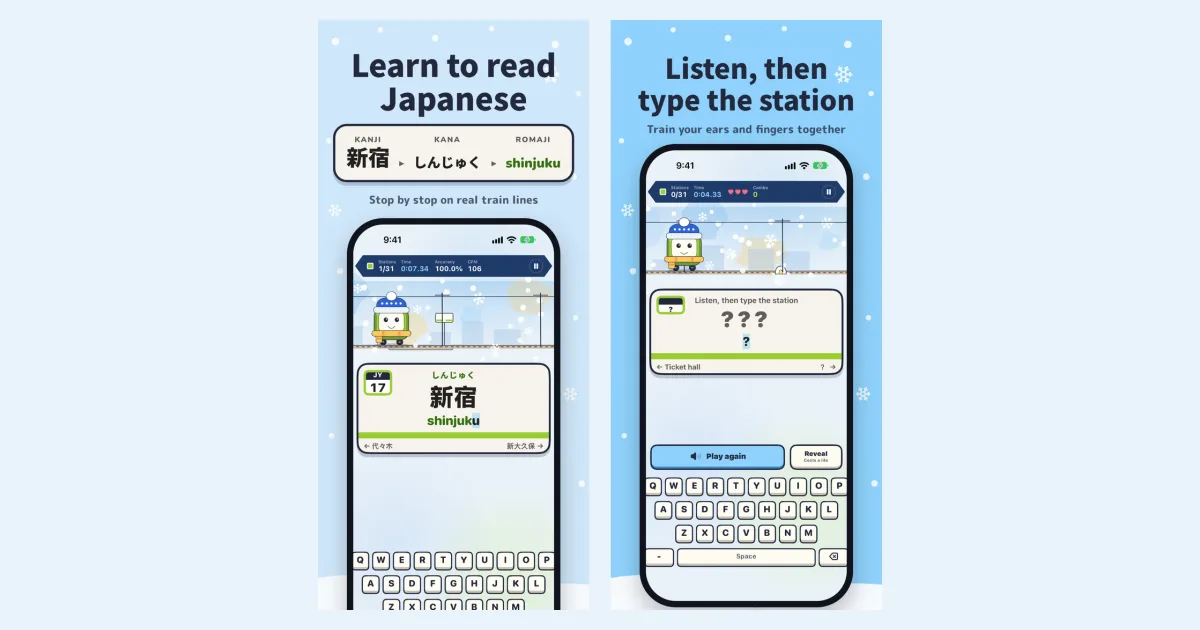
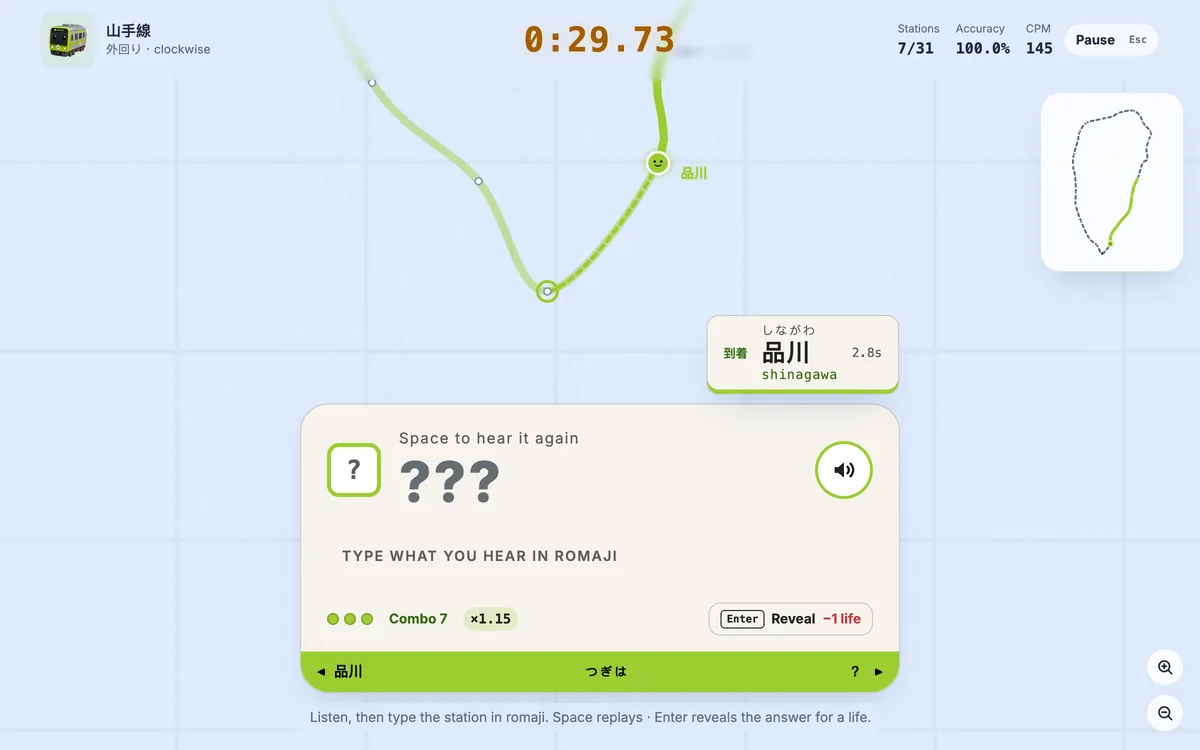
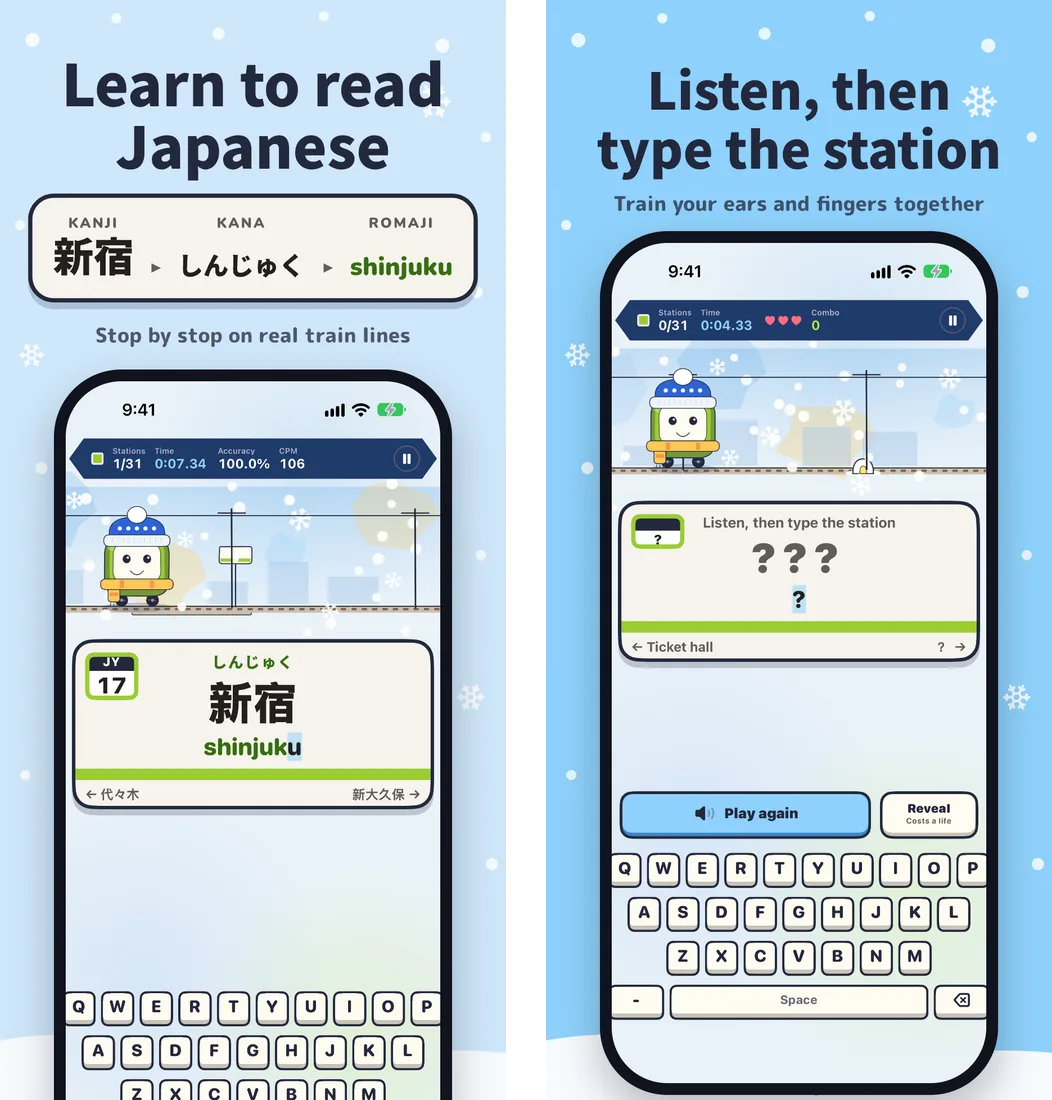
More routes mean more chances to meet a Japanese place name you cannot read yet. Rail Typing for iPhone now has a nationwide passenger railway collection. Use it for a small reading routine: look, listen, then check yourself again.

Original AI-generated concept illustration; not an app screenshot or an actual railway map.
Three names to start with
| Station | Reading | Find it on an app route card |
|---|---|---|
| 五百石 | ごひゃくこく | 富山地鉄立山線 |
| 諏訪川原 | すわのかわら | 富山市内電車(1・2系統) |
| 中書島 | ちゅうしょじま | 京阪宇治線 |
Treat each as a name to learn, rather than a rule you should have guessed. Knowing individual kanji readings does not always tell you how a place name is pronounced.
A five-minute routine
- Look: choose a route with an unfamiliar name. Read the kana before entering the answer. Accuracy matters more than finishing quickly.
- Say: say the full name once. Keep small kana such as ゅ together with the preceding character; ちゅ is one sound unit, not ち followed by ゆ.
- Listen: replay that route in listening mode. The hidden name makes you work from the sound rather than the kanji.
- Check: revisit the name you missed with the reading visible. End by saying it once without looking.
The five minutes are a practice suggestion, not a promise about learning speed. Choose a short route or spend your session on one difficult name. You do not have to turn every new card into a completed checklist.
How do you read an unfamiliar Japanese station name?
Check the whole name’s kana reading, say it aloud, then connect the sound back to the kanji. Do not assume that adding the most familiar reading of each character will produce the place name. Use a station’s published reading or a reliable route entry to resolve uncertainty, then practice recalling that particular name.
The three examples above are taken from Rail Typing’s published iPhone catalog. For 中書島, Keihan’s own station page also gives ちゅうしょじま. Treat the examples as specific names, not rules that determine every other word containing the same kanji.
Break a long name into sound units
A string such as ちゅうしょじま becomes less intimidating when you look at its parts: ちゅ・う・しょ・じ・ま. Small ゅ and ょ combine with the preceding kana. The following う in ちゅう contributes to a long vowel; do not quietly drop it just because the name sounds familiar.
For ごひゃくこく, look at ご・ひゃ・く・こ・く. The similar く and こ sounds near the end make a good accuracy check. For すわのかわら, try す・わ・の・か・わ・ら and make sure you have not lost a small connecting sound while thinking about the kanji. These divisions are a practice aid, not a new spelling of the station.
You can type a name correctly while still hesitating over its sound. Say the name once before entering it and once after you have looked away. That small gap helps distinguish recognizing an answer on the screen from recalling it yourself.
Romaji, kana or listening: which should you use?
| Mode or approach | Main practice | What to watch for |
|---|---|---|
| Visible reading with romaji entry | Connecting a name and its pronunciation | Do not skip reading because the next keys are obvious |
| Kana practice | Following the kana spelling | Small kana and long vowels still matter |
| Listening | Recognizing the name from sound | A remembered station order can help, so test a name again later |
| Selection mode | Practicing without keyboard fluency | Read the chosen answer instead of only recognizing its position |
Keep the route constant while changing one approach. If you change every name and every rule at the same time, a harder score will not tell you which skill needs attention. The iPhone app page describes the app’s modes; the website’s Japanese romaji reference is a useful companion for input spellings.
Turn one missed station into the next session
After a ride, choose just one name you missed or entered hesitantly. Write down the kanji, the kana and the part that caused trouble. “I forgot the long vowel” is more useful for tomorrow than “I am bad at station names.”
Next time, try recalling the reading before opening the answer. Then check it, say it and use it on the route again. If the spelling is easy but the audio is not, spend the next pass listening. If the audio is familiar but the kanji is not, keep the name visible. This is a way to choose practice, not a guarantee about how many repetitions anyone needs.
A week of small, repeatable goals
Start with the two-station Tateyama Cable Car card to make a session easy to repeat. Use another session for Keihan Uji and 中書島. Later, explore the Tateyama railway card for 五百石 and the Toyama tram card for 諏訪川原. Reserve a session for listening to a route you have already seen, then revisit the names that still cause hesitation.
You can also repeat just one chosen line throughout the week. A nationwide catalog is useful because you can find material you care about; it does not make changing routes every day necessary.
Frequently asked questions
What is the reading of 五百石 station?
In the app’s Tateyama Line card, 五百石 is read ごひゃくこく. Learn the complete station name with that reading rather than treating it as a formula for reading similar kanji elsewhere.
How do you read 中書島?
中書島 is ちゅうしょじま, also shown on Keihan’s official station page. It appears on the app’s Keihan Uji card as well as its Keihan Main Line card.
Should I learn romaji or kana first for this practice?
If kana is new to you, visible readings or selection mode offer a starting point. Romaji can help you enter an answer, while kana practice keeps attention on Japanese spelling. Move to listening once you can connect a few names with their readings.
Does listening to station names teach conversational Japanese?
It trains recognition of these names and their sounds. It does not replace conversation, grammar or sentence listening. Use it as a focused part of your Japanese practice rather than expecting station names alone to teach the whole language.
Further reading
For the release scope, see the nationwide railway launch. To choose material for the routine, start with five Japanese route cards.
Download Rail Typing and pick one name you want to recognize the next time you see it.