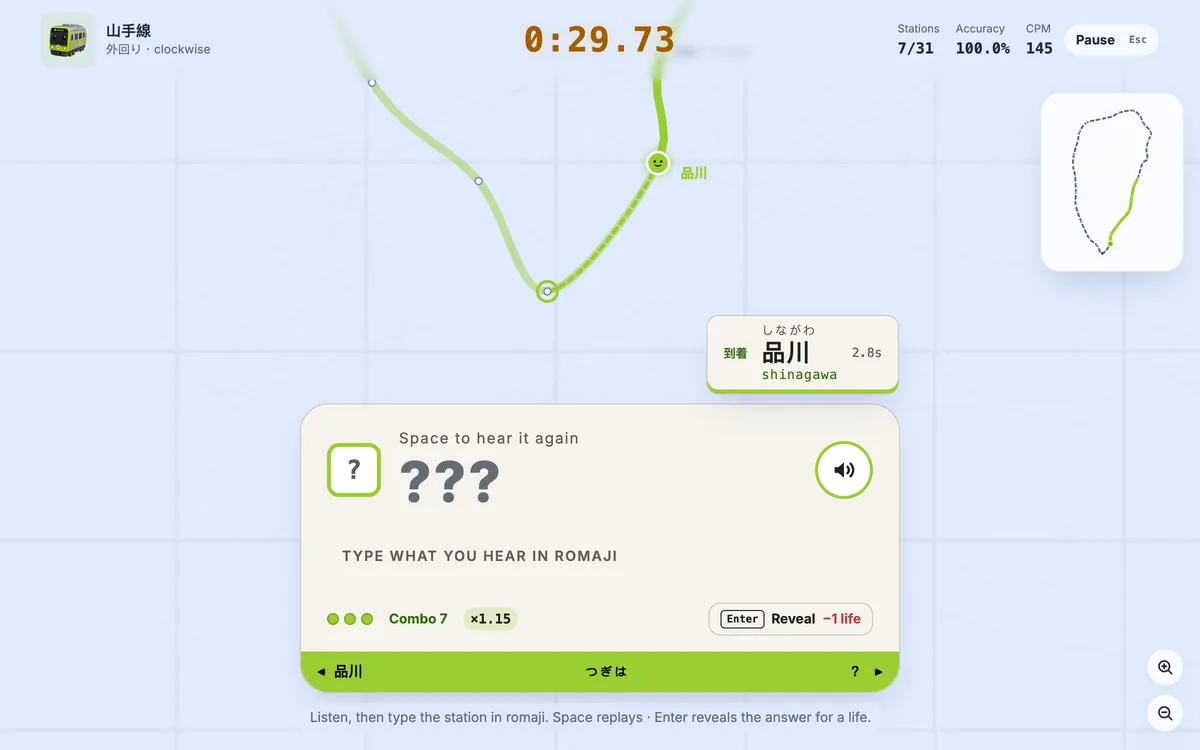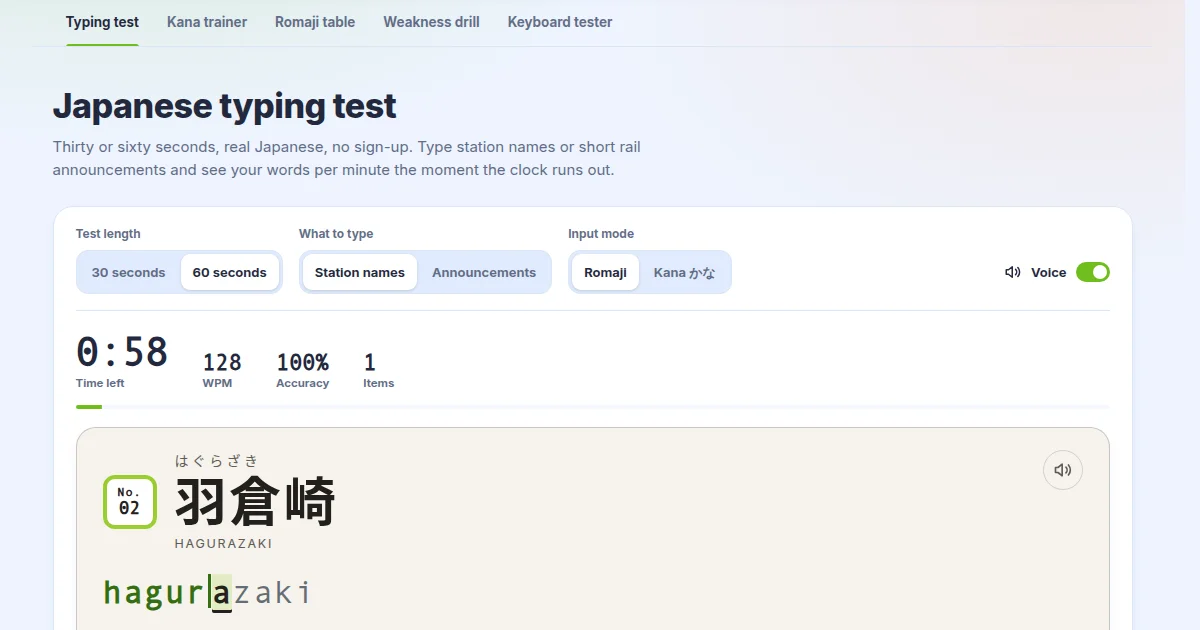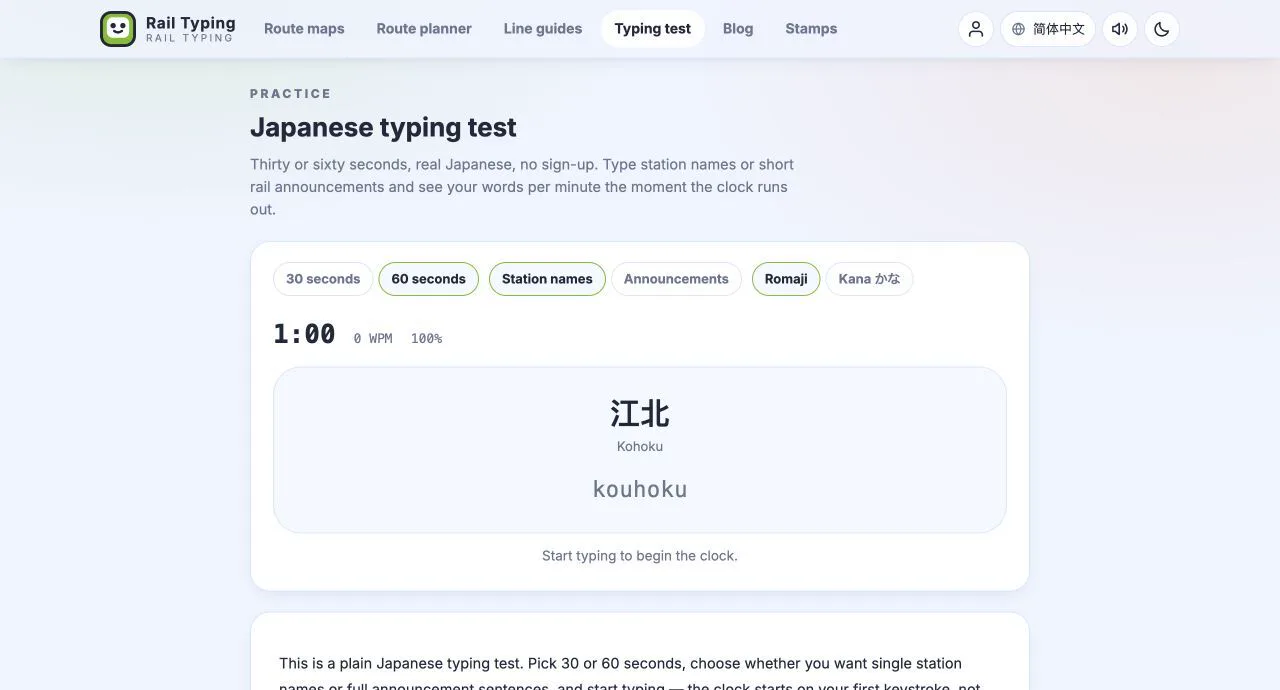
Most typing trainers hand you random words to drill. Tokyo Rail Typing does something better: you type real station names to move a train along a real line, one stop at a time, until the route completes. That single change turns Japanese typing practice into something you actually want to keep doing — and it happens to build exactly the skills a Japanese keyboard demands.
Why real place names beat random drills
Random letter drills train your fingers but not your language. Station names train both at once. Every stop is a genuine Japanese word you will encounter on signs, apps, and announcements, so the muscle memory you build transfers straight to real life.
- Meaningful chunks stick. 新宿, 渋谷, 品川 are words your brain wants to remember, not random noise it forgets the moment the drill ends.
- Natural difficulty curve. Short names like 上野 warm you up; long hubs like 西日暮里 or 高田馬場 stretch you — all on the same route.
- Context you can feel. Watching the train advance gives each keystroke a purpose, which keeps a practice session going far longer than a wall of nonsense words.
Three modes, three different skills
The game's three input modes form a skill ladder. Each one trains a distinct layer of Japanese keyboard fluency.
- Romaji — type the Hepburn spelling on a normal keyboard (
shinjuku,shibuya). This builds raw speed and finger accuracy with zero setup. Start here. - Kana — you still type romaji keystrokes, but the board fills in kana unit by unit, with no IME to interrupt you. This trains your eyes to read the script while your hands stay confident.
- Kanji (IME) — a real Japanese IME, where you type the reading and commit the kanji by segment. This is the real-world skill: the exact motion you use in every Japanese app.
Across all three, wrong keys are simply rejected — the train never moves on a mistake and no backspace is needed. That quietly rewires you toward clean, accurate typing instead of frantic correction.
A suggested practice routine
Structure beats grinding. Here is a session that moves you up the ladder without burning out:
- Warm up in romaji on a short line. The Ginza Line is a great starter — enough stops to find a rhythm, short enough to finish.
- Repeat the same line in kana. You already know the route, so your attention is free to absorb the kana as they appear.
- Graduate to kanji (IME). Once kana feels smooth, switch on the IME and run it again. The names are familiar, so you focus purely on conversion timing.
- Then scale up. Take the whole routine to the Yamanote Line, a 30-station loop that is the flagship endurance test.
Track progress with splits and PBs
Practice only improves you if you can see it working. Every run reports your time, CPM, WPM, and accuracy, plus per-station splits that show exactly where you slowed down.
- Personal bests are stored per line and per mode, so a hard IME run never overwrites your romaji record — each mode keeps its own scoreboard.
- Revisit your splits to target slow stations. If 五反田 costs you every lap, drill that name until it stops being the bottleneck.
- Chase measurable numbers. Watching CPM climb week over week is what turns casual play into real Japanese keyboard practice.
Not sure which mode fits you? Read romaji vs kana vs kanji to choose, pick up more speed tips in how to improve your typing speed, or browse the full blog for line-by-line guides. Then pick a line and start typing.