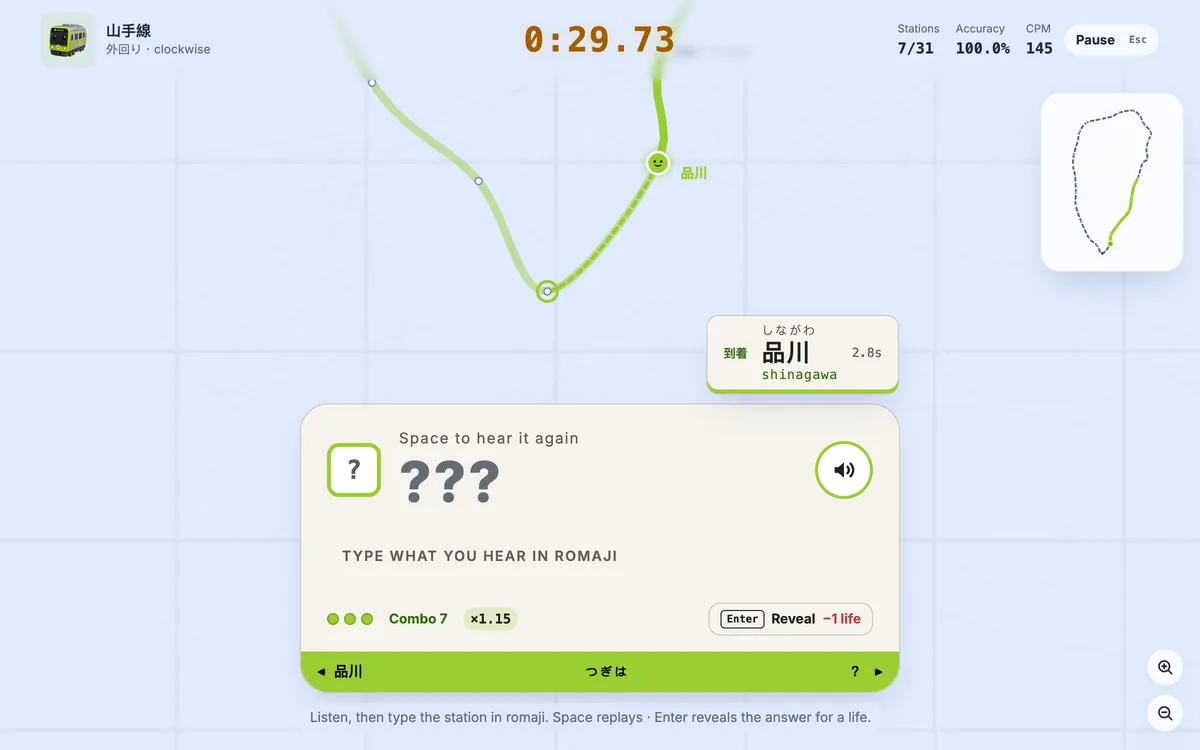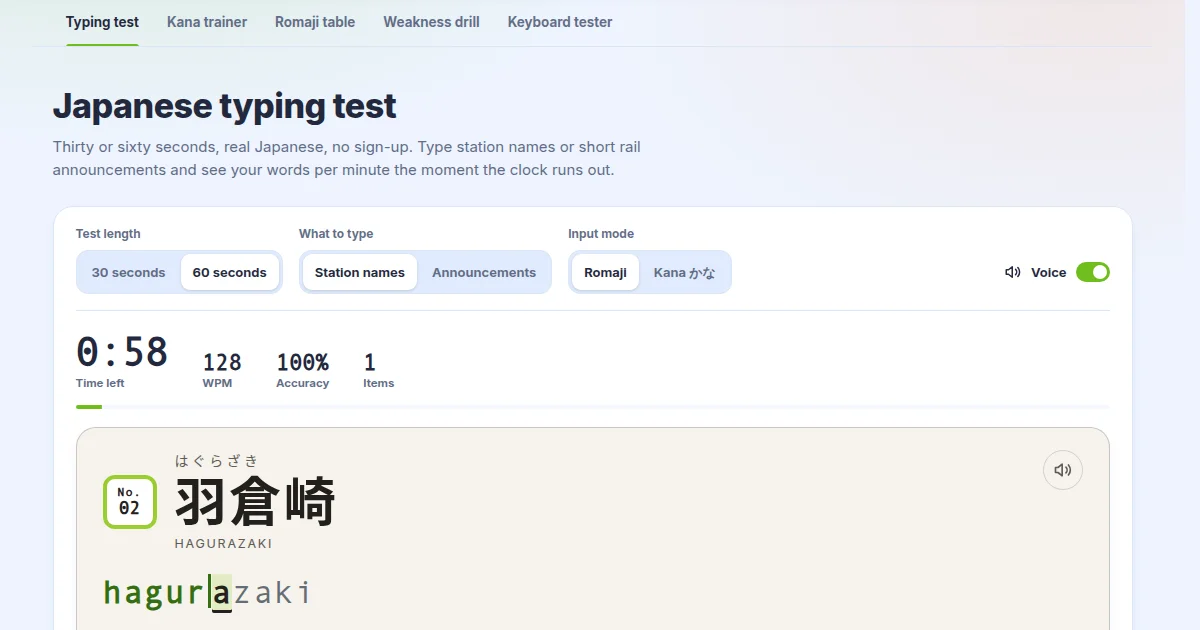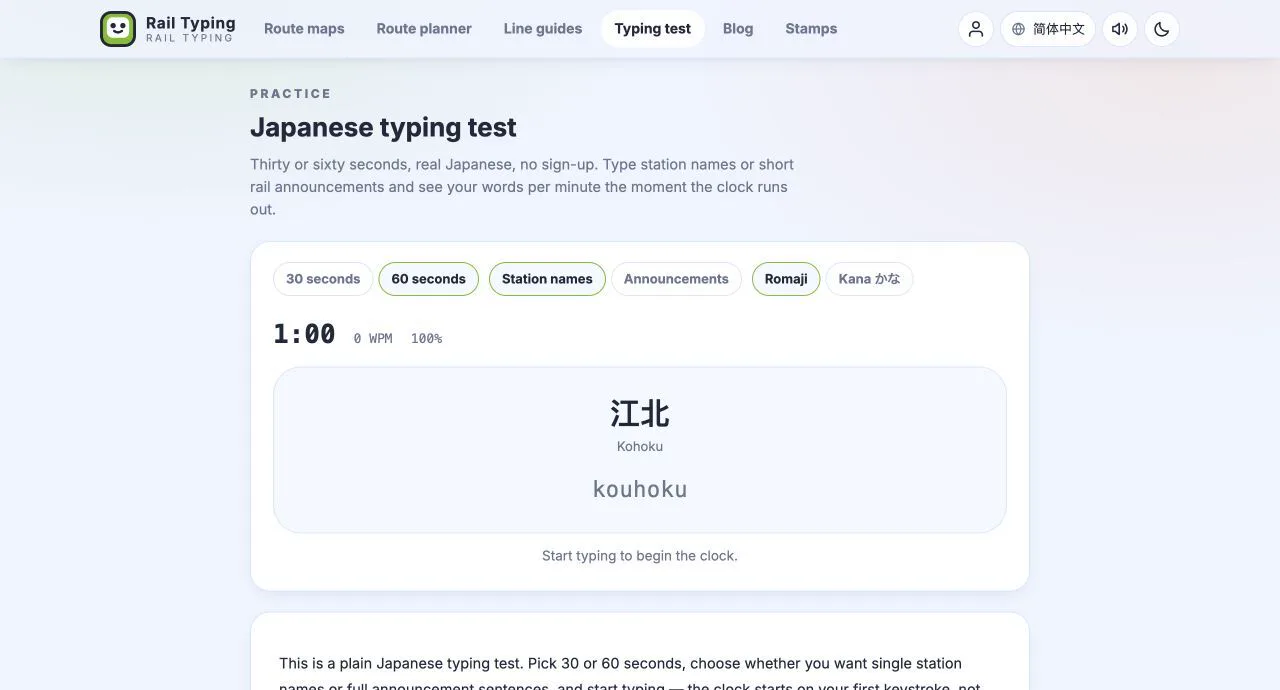
A train typing game is exactly what it sounds like: a typing game with trains, where every keystroke drives a train forward along a real railway line. In Tokyo Rail Typing you pick a line, a starting station and a direction, then race the clock by typing each upcoming station's name. It sits at the intersection of a typing test and a rail simulator, and because the targets are genuine Japanese station names, it doubles as painless Japanese station typing practice. If you have ever wanted a reason to type faster that is more fun than copying random sentences, this is it.
What is a train typing game?
The genre is known in Japan as 電車タイピング (densha typing). The idea is simple. Instead of typing arbitrary words, you type the names of stations in the order a real train visits them. Type the name correctly and the train pulls into that station; miss and you stay put. Reach the terminus—or complete a full loop—and you get your finishing time, characters per minute (CPM), words per minute (WPM) and accuracy.
What makes it stick is the theme. A plain typing drill has no destination, but a train has a route, a rhythm and a sense of forward motion. Each station is a small, satisfying checkpoint, and the map gives you something to look at other than a blinking cursor.
Why typing station names builds real speed
Station names are short, varied and repeat common Japanese sound patterns, which makes them ideal typing fuel:
- Bite-sized targets. Most names are two to five moras, so you get constant starts and stops that train your reset speed, not just raw bursts.
- Real vocabulary. You are typing 新宿, 渋谷, 東京 and 上野—words you will actually recognize on maps, signs and apps.
- Built-in variety. A single line mixes easy names with tongue-twisters, so no run feels like grinding the same word list.
Because every run on a line covers the same route, your times are directly comparable. Chasing your own record is a much stronger motivator than a generic score, and it is why a train typing game can quietly turn into a daily habit. For a structured plan, see our guide on how to improve typing speed.
Three ways to type: romaji, kana and kanji
Tokyo Rail Typing supports three input modes, so it fits complete beginners and Japanese learners alike:
- Romaji — type Hepburn romaji on a normal keyboard. The friendliest entry point and the best place to start.
- Kana — still typed as romaji, but the board fills in kana as you go, with no IME conversion to fight.
- Kanji (IME) — use a real Japanese IME and commit each station's kanji, the most authentic mode and the fastest ceiling.
Not sure which to choose? Our three Japanese typing modes and romaji vs kana vs kanji posts break down the trade-offs. Personal bests are tracked per line and per mode, so experimenting never overwrites a record.
Learn Tokyo geography while you play
Type the Yamanote Line enough and the loop of Tokyo's biggest hubs stops being trivia and starts being muscle memory. Play the Ginza Line and you trace the city's oldest subway from Asakusa to Shibuya. Over time you absorb which stations connect where, which lines cross which, and how the network actually fits together—all by playing. Browse the route maps to see every line laid out.
Solo runs, splits and live battles
Every run gives you per-station split times so you can spot the exact stretch that slows you down. When you want a challenge with a pulse, live typing battles put you in a real-time 1v1 race against a friend on the same route and rules—the winner is decided by typing alone.
Try it in the game
The fastest way to understand a train typing game is to play one lap. Head to the Yamanote Line in romaji mode, pick a start and a direction, and type your way around Tokyo. New here? Start with our getting started guide, then see how fast the city goes by.