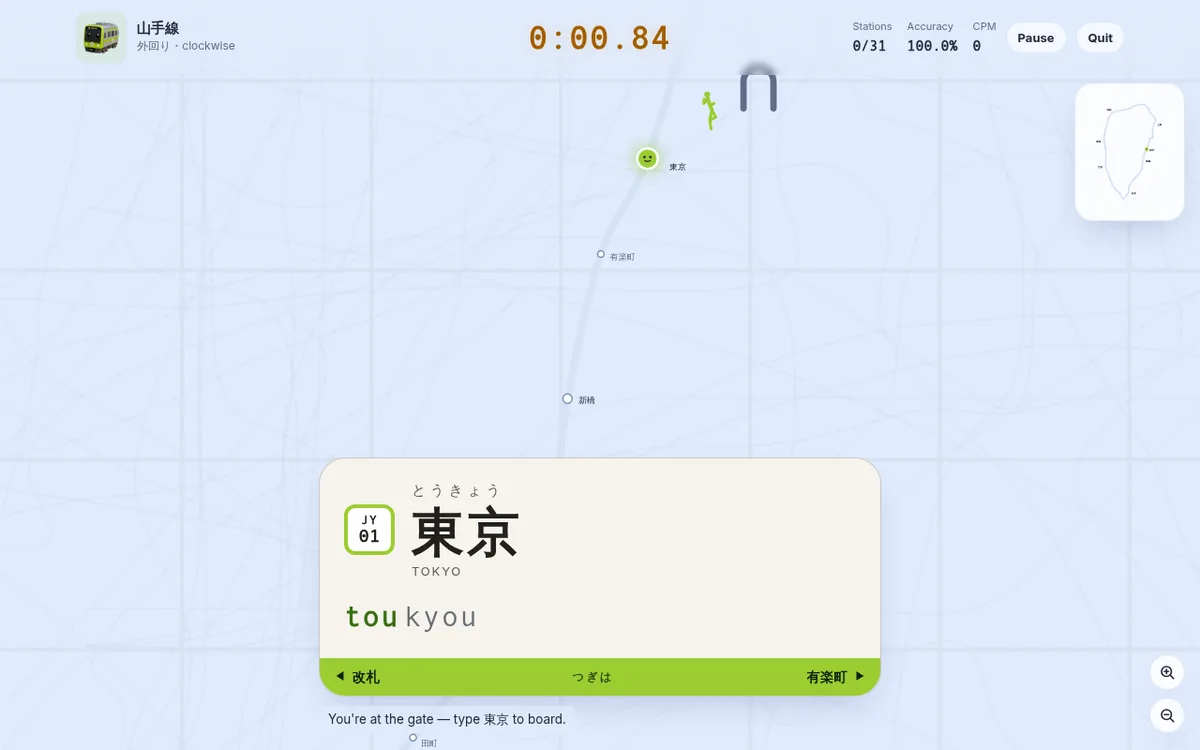
Practising a line is a loop: run it, see where you lost time, run it again. Until this week the "run it again" half of that loop went through the mouse — the result page's play again button, or quitting out to the setup page and starting over. Two changes have just landed that take the mouse out of it.
Bind one key, restart from anywhere
On any line's setup page — the Yamanote Line, say — there is a new retry hotkey field under the audio settings. Click it, press the key you want, and that key now restarts a run instantly, with exactly the settings you are already using.
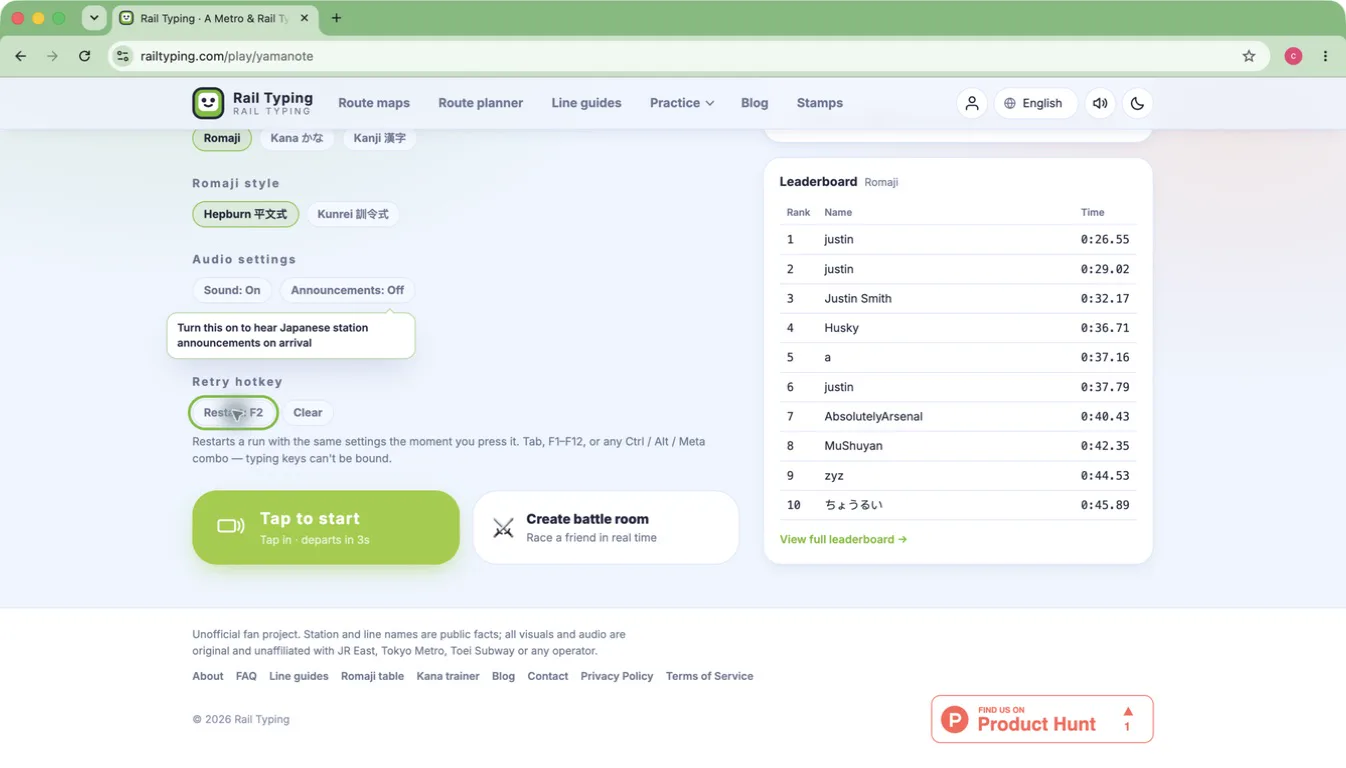
It works in the three places you would want it:
- Mid-run. No pausing, no quitting, no menus. The train resets to your start station and the countdown begins again.
- On the pause overlay. The overlay tells you which key is bound, in case you forget.
- On the result page. Same thing as clicking play again, without moving your hands.
Nothing is bound by default. If you never open that setting, the game behaves exactly as it always has — this is for the people running the same lap fifteen times in a row, not for everyone else.
Why you cannot bind the letter R
The first thing most people try is a plain letter, and the recorder turns it down. That is not fussiness: in this game every printable key is already spoken for. You type station names with them. A retry bound to R would fire in the middle of 六本木.
So the bindable set is deliberately narrow — the keys typing can never claim:
- Tab, on its own.
- F1 through F12, on their own.
- Anything held with Ctrl, Alt or Meta (⌘) —
Ctrl + R,Alt + 1, whatever you like. Modifier combinations are already ignored by the typing engine, so they are free.
Two keys stay off the list even so. Esc already pauses a run, and Enter belongs to the IME — in kanji mode it is how you confirm a conversion candidate, and taking it away would break typing at exactly the wrong moment.
While the Japanese IME is composing, the hotkey stands down entirely. None of the bindable keys are ones an IME uses for candidate selection anyway, but the check is there regardless: a candidate list should never be yanked out from under you.
The abandoned run leaves no trace
When you restart mid-run, the run you walked away from is simply dropped. It records no result, touches no personal best, and submits nothing to the leaderboard — exactly what already happens when you quit a run.
The new run, on the other hand, is an ordinary run in every way. It gets its own timer starting from zero, so a restart never inherits the paused time of the run before it, and finishing it records a result, updates your personal best and posts to the leaderboard as usual. Restarting is not a way to escape a bad time; it is a way to stop wasting the twenty seconds you would have spent clicking back to the start.
Every line remembers your last setup
The second change is quieter. Each line now remembers the choices you made on it last time: the start station on a loop line, the direction, the input mode, and your romaji style. Come back to the Ginza Line tomorrow and it opens on the same configuration you left it with — press start and go.
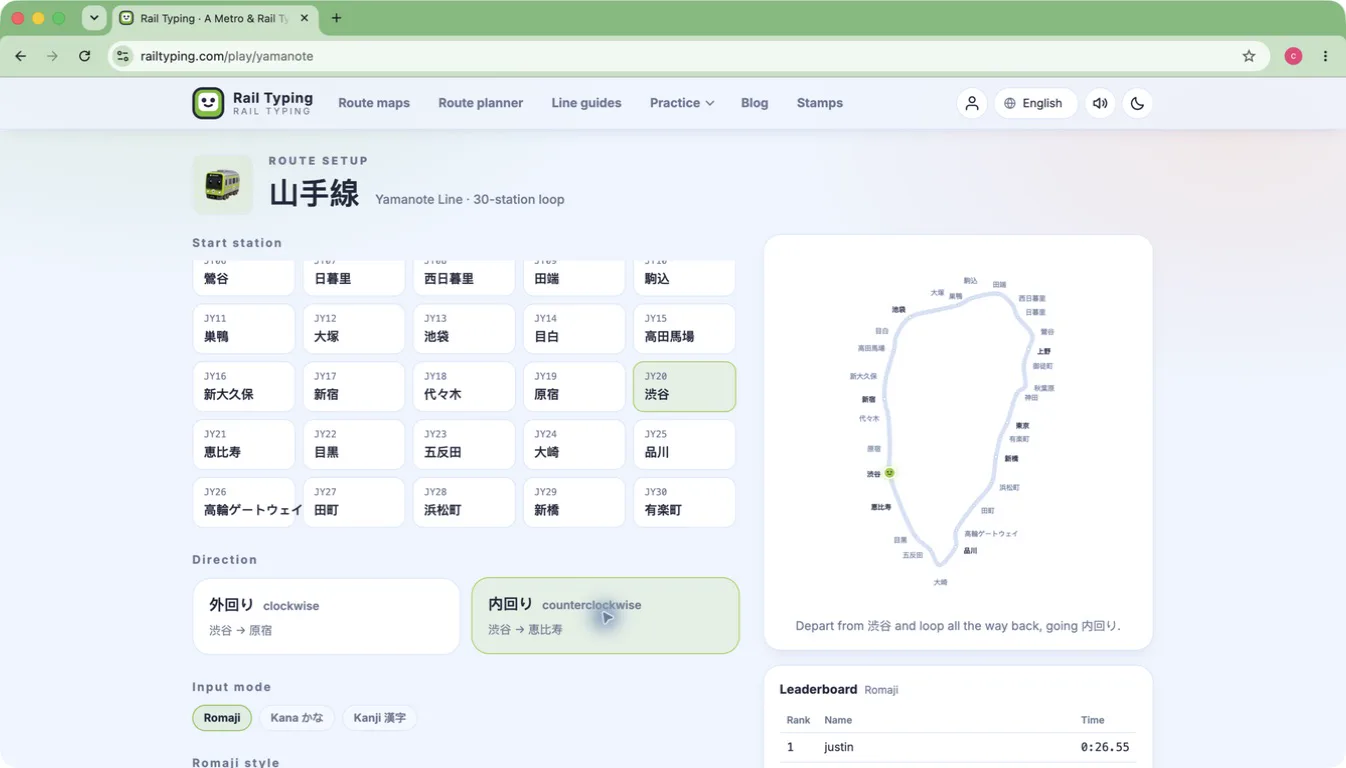
It is stored per line, because that is how people actually play. You might practise the Yamanote Line clockwise in kana mode and the Ginza Line in romaji; one global setting would make you re-pick every time you switched. The input mode and romaji style also carry across as a fallback, so the first time you open a line you have never played, it starts from how you like to type rather than from the default.
What comes back is validated against the line before anything is restored, field by field. If a line revision drops the station you used to start from, that one choice is discarded and your direction and mode survive. And a mode that a line does not offer never leaks in — open a London Underground line after a session of kanji practice and it will not try to put you in kanji mode, because those station names are typed as Latin text.
All of this lives in your browser, alongside your results and personal bests. Nothing about it needs an account.
What the loop looks like now
Put the two together and a practice session goes: open the line, press start, run it, press one key, run it again. The only decision left is the one that matters — which line, and how you want to type it.
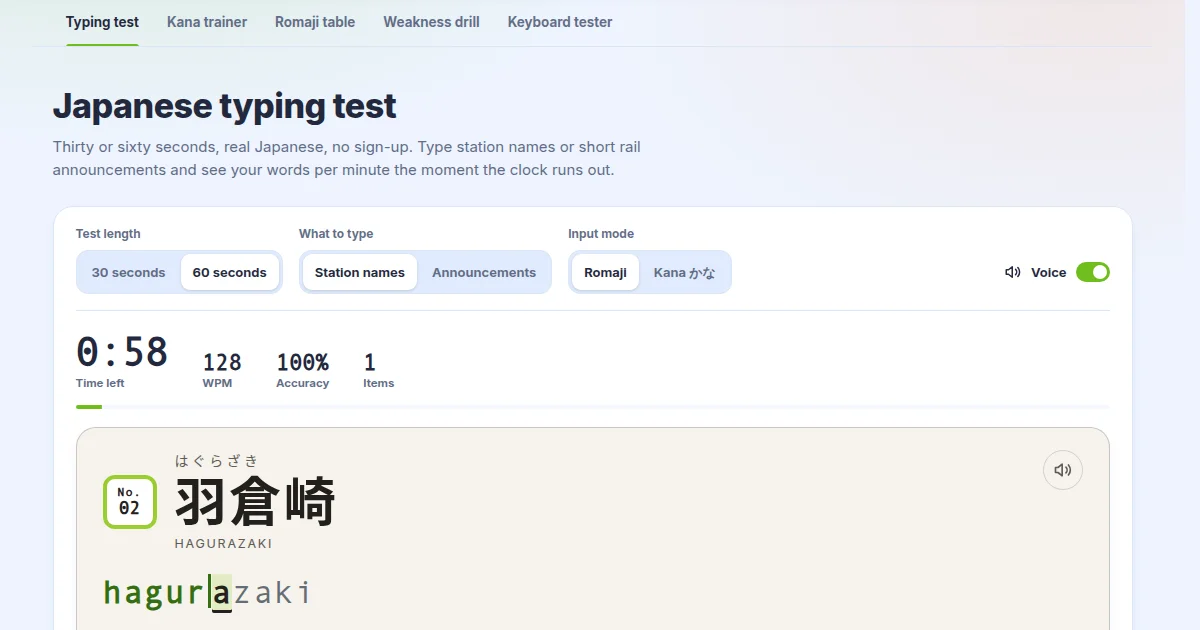
If you want somewhere to point that at, the weakness drill builds a run out of the stations you keep fumbling, and the Japanese typing test is the quickest way to see whether the practice is moving the number. If a key is not registering at all, that is what the keyboard tester is for.